You can have a policy document, a review board, and a stack of audit findings, and still miss the actual gap that matters. The incident usually proves it. Someone found a way around one channel, one workflow, or one boundary, and the policy was never the problem, the enforcement path was.
That's the operational reality of policy enforcement. It's not the sentence in the handbook or the line in the security standard. It's the runtime control that decides whether a request, change, action, or release is allowed to happen, and whether that decision is applied consistently across the places where work gets done.
Table of Contents

- What Policy Enforcement Actually Means in Practice
- Comparing Enforcement Models and Architectures
- Core Enforcement Patterns and When to Use Them
- The Technical Architecture of Enforcement Systems
- Implementation Checklist and Metrics That Matter
- Common Enforcement Pitfalls and How to Avoid Them
- How Vision Enables Practical Policy Enforcement
What Policy Enforcement Actually Means in Practice
A team usually learns the difference between policy and enforcement right after an incident review. The policy says that only approved users can access sensitive data, only reviewed code can reach production, and only certain actions can be taken from managed devices. In practice, one service accepted the request, one workflow skipped the check, and one operator found a path that never hit the control.
That's why policy enforcement is better understood as a runtime mechanism than as a compliance artifact. It's the part of the system that intercepts an action and decides, on the spot, whether that action aligns with the rules. If the rule exists on paper but the action can still happen through another path, enforcement is incomplete.
The long-run growth of enforcement capacity in government gives a useful analogy. In the United States, police staffing roughly doubled between 1980 and its peak in 2017, and inflation-adjusted state and local police expenditures rose from about $52.5 billion in 1977 to $151.6 billion in 2023. Yet spending stayed a stable share of state and local budgets at just over 3%, which shows enforcement can become a durable structural function without dominating the budget mix, as described in the Council on Criminal Justice's overview of policing trends, policing by the numbers. The lesson for organizations is similar, enforcement isn't a one-time project. It becomes part of the system's operating structure.
Where enforcement actually lives
Enforcement shows up in identity, data access, deployment controls, and operational workflows. A login policy is meaningless if privilege escalation bypasses it. A data policy is weak if exports can happen through an unmonitored integration. A change-management policy fails if production can be altered outside the approved pipeline.
Practical rule: if a policy doesn't have a place where the system can stop the action, it's guidance, not enforcement.
That's also why post-incident cleanup matters. The InsecureWeb post-breach guidance is a useful reminder that containment and remediation only come after the underlying control gaps are understood. Organizations that treat enforcement as periodic review tend to discover the failure after the damage is already done.
For privacy-sensitive systems, the boundary matters just as much as the rule. The internal design of access paths, approvals, and auditability determines whether policy is real or decorative, and that's where engineering discipline matters most. A good starting point is aligning policy language with implementation boundaries, then checking whether every relevant path has a control point, as the internal privacy model in Vision's privacy approach emphasizes in practice.
Comparing Enforcement Models and Architectures
The quickest way to evaluate an enforcement design is to ask two questions. Does it block bad actions before they happen, or only report them afterward. And does one central engine decide everything, or do multiple enforcement points apply the rules close to where work happens.
Preventive versus detective enforcement
Preventive enforcement stops unauthorized actions in real time. If an API call violates policy, it never completes. If a deployment doesn't meet the approval rule, it doesn't proceed. This is the safer model when the action is irreversible or the blast radius is large, but it can create friction if the rules are too broad, the latency is too high, or the false blocks are frequent.
Detective enforcement records or flags a violation after the action occurs. That might be enough for lower-risk activities, or for environments where the organization needs visibility before it can safely block. The trade-off is obvious, you get speed and flexibility, but you're relying on follow-up to contain the damage.
Centralized versus distributed enforcement
A centralized model routes decisions through a single policy engine or policy decision point. That gives you consistency, simpler governance, and one place to version rules. The downside is operational bottleneck risk, and in larger environments that can become a scaling concern.
A distributed model places enforcement at service boundaries, endpoints, or application layers. This scales better and keeps decisions close to the action, but it's harder to keep every control synchronized. Teams often think they've standardized policy, then discover one service is on an older rule set or an integration path never got instrumented.
The right answer usually isn't pure centralization or pure distribution. It's a central source of truth with distributed controls that can stop the action at the edge. That's the pattern most mature teams settle on, because it respects both consistency and throughput.

For teams already thinking in zero-trust terms, the same logic applies cleanly. The zero trust principles for business framing is useful because it treats trust as something continuously evaluated, not assumed once at login.
Operational shortcut: use preventive controls for high-impact actions, detective controls for visibility-heavy workflows, and don't let a centralized policy brain fool you into thinking you've covered every execution path.
Core Enforcement Patterns and When to Use Them
The patterns that work in production usually solve one of four problems, traceability, scale, granularity, or human judgment. Most organizations need a mix, not a single ideology.
Policy as code and role-based control
Policy as code turns rules into versioned, testable artifacts. That matters because teams can review changes, diff them, and catch regressions before rollout. It's strongest when policy changes often and when you need a clear promotion path from draft to production. The cost is discipline, you need testing, review, and a place to store policy alongside the systems it governs.
Role-based access control stays popular because it's understandable. Assign permissions to roles, assign users to roles, and keep the model simple enough that administrators can reason about it. It works well for stable org structures, but it gets rigid fast when people wear multiple hats or when access needs vary by context.
Attribute and context based control
Attribute-based access control looks at the subject, object, action, and environment before granting access. That gives you much finer decisions than RBAC, especially for data access or operational tools where the same person may be allowed one action in one environment but not another. The trade-off is complexity, because attribute quality becomes part of the security problem.
Context-based access control adds live signals, such as device posture, location, or behavioral context. It's useful when risk shifts during the request, not just at login. The failure mode is brittle dependence on signals that can be noisy, incomplete, or too strict for real work.
Approval workflows and automated guardrails
High-risk actions often need approval workflows. Human sign-off slows things down, but that's the point when the action could affect customers, revenue, or regulated data. The mistake is using approvals for everything, which creates bottlenecks and encourages shadow paths.
Automated guardrails work best for boundaries that shouldn't be crossed, like disallowed destinations, unsafe promotions, or unreviewed production changes. They keep drift contained without forcing every routine action through a person. Use them when the rule is crisp and the exception rate should stay low.
The cleanest implementation guidance is to map each pattern to the risk it controls, then accept that some risks need more than one pattern. That's why a modern stack often combines policy as code, RBAC, ABAC, context signals, and human approvals in the same workflow, just at different decision points.
For a practical platform example of how these patterns translate into real product workflows, the Vision use cases page shows how scoped access and approvals can be applied across operational tools without turning every change into a manual project.
The Technical Architecture of Enforcement Systems
Most enforcement systems fail for one boring reason, the control is in the wrong place. The policy might be correct, but the action reaches a path that never asks for a decision, or the decision exists but nothing blocks the request.
PEP and PDP separation
In access-control architecture, the Policy Decision Point evaluates the rules, and the Policy Enforcement Point intercepts the request and acts on the answer. That split matters because it keeps decision logic separate from execution logic, which makes both easier to test and govern. It also supports real-time, attribute-aware authorization instead of static permission checks.
The enforcement point has to be close enough to the action to matter. If the check happens after the write, after the deploy, or after the call leaves the system, it's already too late. That's why enforceable-security-policies literature treats the monitor as runtime-checkable, not archival.
Multi-boundary enforcement in AI and identity systems
The newer problem is that one access check isn't enough when a system can act repeatedly. Guidance on Zero Trust for agentic AI argues that enforcement has to happen at four boundaries, model gateway, tool use, retrieval, and runtime egress. That changes the architecture from “who can start” to “what can this system do at each step.”
That shift matters in identity systems too. A user or agent can pass the first gate and still accumulate privilege through tool chaining, cached trust, or repeated calls. Initial authentication only proves identity at one point in time. It doesn't guarantee safe behavior across an entire transaction chain.
The operational answer is layered controls, backed by logging and alerting. Audit logs tell you what happened, monitoring tells you what needs attention now, and alerting makes sure the violation doesn't sit until the quarterly review. Continuous enforcement beats periodic oversight.
Design rule: build for interception first, then add decisioning, then make sure every permit and deny produces a durable audit trail.
For CTOs trying to compare architectures against delivery pressure and governance needs, the Vision for CTOs page is a useful reference point for how controlled release, review, and scoped permissions can be assembled into a production-safe flow.
Implementation Checklist and Metrics That Matter
A good implementation starts with the risk, not the tooling catalog. If the policy exists because of regulatory exposure, data sensitivity, or operational blast radius, that driver should shape every enforcement choice. Otherwise, you end up building controls that look mature and fail on the exact path that matters.
A practical rollout sequence
- Map policies to risks and compliance drivers. Tie each rule to a real business or regulatory exposure, then kill the rules that don't change behavior.
- Define enforcement points at boundaries. Look for the requests, approvals, exports, deploys, and agent actions that can be intercepted before they complete.
- Pair centralized policy definition with distributed controls. Use IAM, DLP, CASB, NAC, endpoint controls, and audit logging together so one broken channel doesn't become the only channel that matters, consistent with the enterprise guidance on policy enforcement from Rubrik's policy enforcement overview, policy enforcement practices.
- Instrument violation handling in real time. Block, alert, or escalate based on severity. Don't wait for a scheduled review to learn the control failed.
- Track outcomes, not just policy counts. Measure violation rates, incident-response rates, and audit outcomes so you can see whether the controls are reducing risk.
- Refine by channel. If email, web, endpoint, and API paths behave differently, treat them as separate enforcement surfaces.
Metrics that tell the truth
The most useful metrics are the ones that show whether enforcement is working across channels. Time to detect violations tells you how quickly the organization learns about a failure. False positive rate shows whether people will try to route around the control. Policy coverage gaps expose where no control exists at all. Control effectiveness by channel tells you which path is weakest.
What doesn't help is counting how many policies were written. A large policy library can coexist with a brittle enforcement posture. The question is whether the rule is applied where the action happens, and whether people can still complete risky work through an unmonitored path.
Good metric, bad metric: if the number changes but the risk doesn't, you're measuring paperwork, not enforcement.
For teams with enterprise rollout requirements, identity integration matters. SSO, SCIM, and audit logging make it possible to keep controls aligned with real user state instead of stale spreadsheets. That's especially important once access starts scoped and grows over time.
Common Enforcement Pitfalls and How to Avoid Them
The biggest enforcement failures usually don't come from obscure policy language. They come from assumptions that feel safe until a real user, real workload, or real exception flow shows up.
Treating enforcement as a project instead of an operating state
Teams often stand up a control, declare success, and move on. Then the integration changes, a new tool gets added, or a workflow shifts, and the control stops covering the new path without any notice. The countermeasure is simple, keep testing enforcement as a live system, not a completed deliverable.
Ignoring equity and harm
A narrow focus on compliance mechanics can hide unfair outcomes. The National Academies' guidance stresses analyzing alternatives, involving affected communities, and planning for fair distribution of benefits and burdens, while the California Health Care Foundation's framing on equitable enforcement asks whether enforcement primarily benefits underserved communities or creates harm. That's not a side concern, it's part of whether enforcement is legitimate.
Relying on delayed visibility
Periodic audit alone is too slow for most modern systems. If a violation is only found weeks later, the control failed operationally even if it looks fine on paper. Continuous monitoring and alerting reduce that gap, especially for actions that are reversible only in theory.
Creating friction that drives workarounds
If enforcement blocks ordinary work too often, users will look for exceptions, informal approvals, or alternate tools. That doesn't mean you should weaken the rule, it means you should redesign the control at the right granularity. The best controls feel restrictive only on the actions that are risky.
Measuring policy presence instead of policy effect
A long policy register can hide a weak implementation layer. The useful test is whether the control changes behavior and reduces risky actions. If you can't show that, the policy may be documented, but it isn't enforced.
How Vision Enables Practical Policy Enforcement
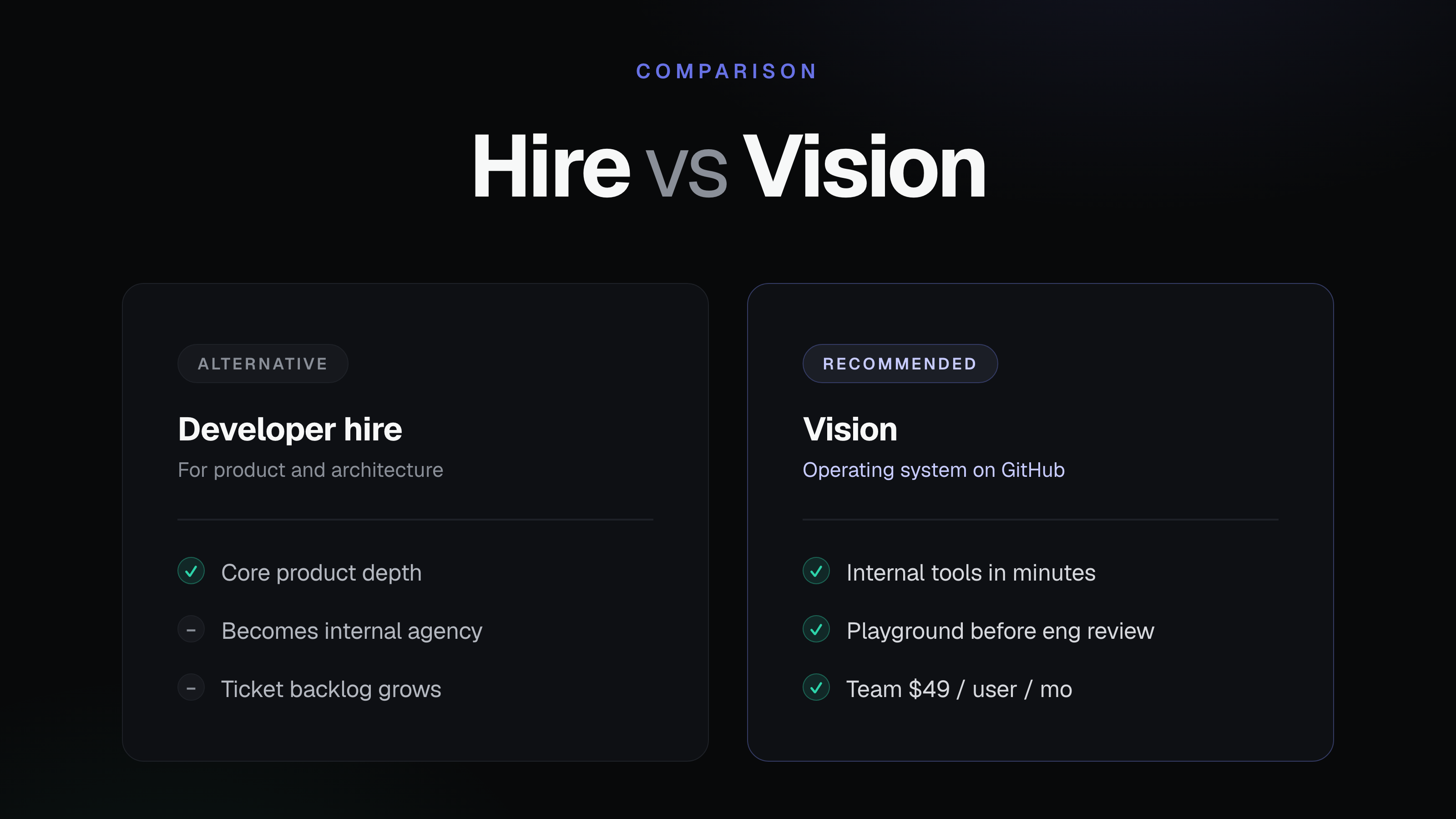
Vision maps well to enforcement principles because it treats access, review, and release as separate control points instead of one big permission step. Its role-based access control with scoped permissions per workspace, tool, and surface is a good example of preventive enforcement at the right level of granularity. Access starts narrow, then expands as trust is earned, which fits the way mature teams delegate risk.
The product's live preview environments add a detective layer before promotion. Engineers and business users can see the impact of a change before it reaches production, which is exactly where many teams need a second look. That matters because many enforcement failures come from changes that were technically “approved” but never validated in context.
Pull request review keeps engineers in the loop without turning nontechnical teams into bottlenecks. Controlled promotion and one-click rollback add the guardrails that matter when a change does slip through. Enterprise features like SSO, SCIM, and audit logs fit the governance side of enforcement, since identity state and change history stay visible instead of scattered across tools.
The bigger point is that Vision aligns with the operational reality of policy enforcement, centralized control where it helps, distributed execution where it's needed, and explicit promotion where production risk is highest. That combination is what most organizations are trying to build by hand, and it's the difference between a policy that exists and a policy that holds.
If you're trying to tighten enforcement without freezing delivery, visit Vision to see how scoped permissions, live previews, pull request review, and controlled promotion can fit into your existing workflow. It's a practical way to give nontechnical teams more autonomy while keeping engineers, identity controls, and auditability in the loop.
Related Articles

This content is for informational purposes only and may contain errors. Please contact us to verify important details.