How to Build Software Without a Technical Team in 2026

Quick answer: How to build software without a technical team depends on whether you already have a product or a site. If you do, Vision (vson.ai) lets founders and ops paste a URL or connect GitHub, mock changes in Playground, then ship reviewable code through preview, promote, and rollback. If you have nothing yet, prototype with a greenfield builder, then move onto a real repo before customers arrive. "No technical team" cannot mean "no production path."
Can you really build software without engineers?
You can build a lot of the software a company needs without a bench of developers. You should not skip guardrails.
Nontechnical people were never the weak link. They were locked out of the repo. Vision's founder describes a bet: put guardrails in first, then let nontechnical teammates ship. An engineer who had said they should never touch the codebase later said they delivered more than expected. A nontechnical CTO vibe coded a full 3D platform, with real customers and $5M raised. Access was the constraint, not IQ.
Early Vision workspaces shipped 117 production updates in 20 days, with 1,027 files changed safely. Most of the people shipping had never written code. That stat belongs here because this post is about unlocking builders who are not "the technical team."
Every tool is good at prompt #1. Vision is built for prompt #500: the same site and tools, still coherent after months of English-language edits.
What should you build first if you have no technical team?
Rank work in this order:
- The customer-facing product. If this does not exist, you may still need a technical cofounder, a contractor, or a greenfield AI builder for v1.
- The website. Marketing pages, blogs, migrations off Webflow or WordPress.
- Internal tools. Admin panels, reports, ops dashboards, light integrations.
Vision is strongest on (2) and (3) once a repo exists. It can also clone an existing site into an editable codebase (same URLs, content, and design, self-hosted assets, SEO preserved with redirects, meta tags, and sitemaps).
Site import numbers (the hero proof for this post)
Published migration examples:
- Webflow clone: 214 pages, 253 CMS items, 1,144 assets, about 1.5 hours, about $44 in AI credits at the time of that run
- WordPress clone: 17 pages, 20 blogs, about $20
One customer path (Assistantly-style): paste the live URL, keep animations and structure, then keep editing in English ("make 5 new pages about these topics"). A paraphrased reaction from that kind of workflow: I fear clicking around software may be over. More examples sit on use cases.
How do you build without a technical team, step by step?
0. Start in Playground (less intimidating than Agent)
If nobody on the team reads code, do not open with a scary agent chat. Switch Agent to Playground. Prompt something like "I want to improve the homepage. Make a few mocks of the hero moved up." Iterate on mocks. Only then click Build so Vision implements the chosen design on the real repo. Playground is the on-ramp for nontechnical teams: mocks first, Build second.
1. Get the work into a real repo
If the site lives only in Webflow or WordPress, clone it into code you control. If the product already lives on GitHub, connect that. AI tools that only generate a parallel app create a second company to maintain.
2. Describe outcomes, not tickets
"Build a P&L page from this spreadsheet and a stakeholder tracker for events" is a better brief than "create a React table." An ops duo with zero dev experience shipped that shape of tool in Vision from a verbal description.
3. Name the guardrails (so you do not get spaghetti)
Without a technical team, confidence is the product. Vision is set up so changes can:
- Pass TypeScript (
pnpm typecheck/npm run typecheck) - Run unit tests for new functions
- Reuse existing code before inventing new modules
- Follow DESIGN.md for design and copy consistency
- Ship only through preview, explicit promote, and one-click rollback
That is how you avoid spaghetti without a staff engineer watching every keystroke.
4. Connect the tools you already pay for
Internal software that cannot talk to Slack or Calendly becomes another login. Example pair:
- Slack: alert
#opswhen a form submits - Calendly: show today's bookings on an internal dashboard next to the lead record
5. Keep one technical reviewer on call, even if they are not "the team"
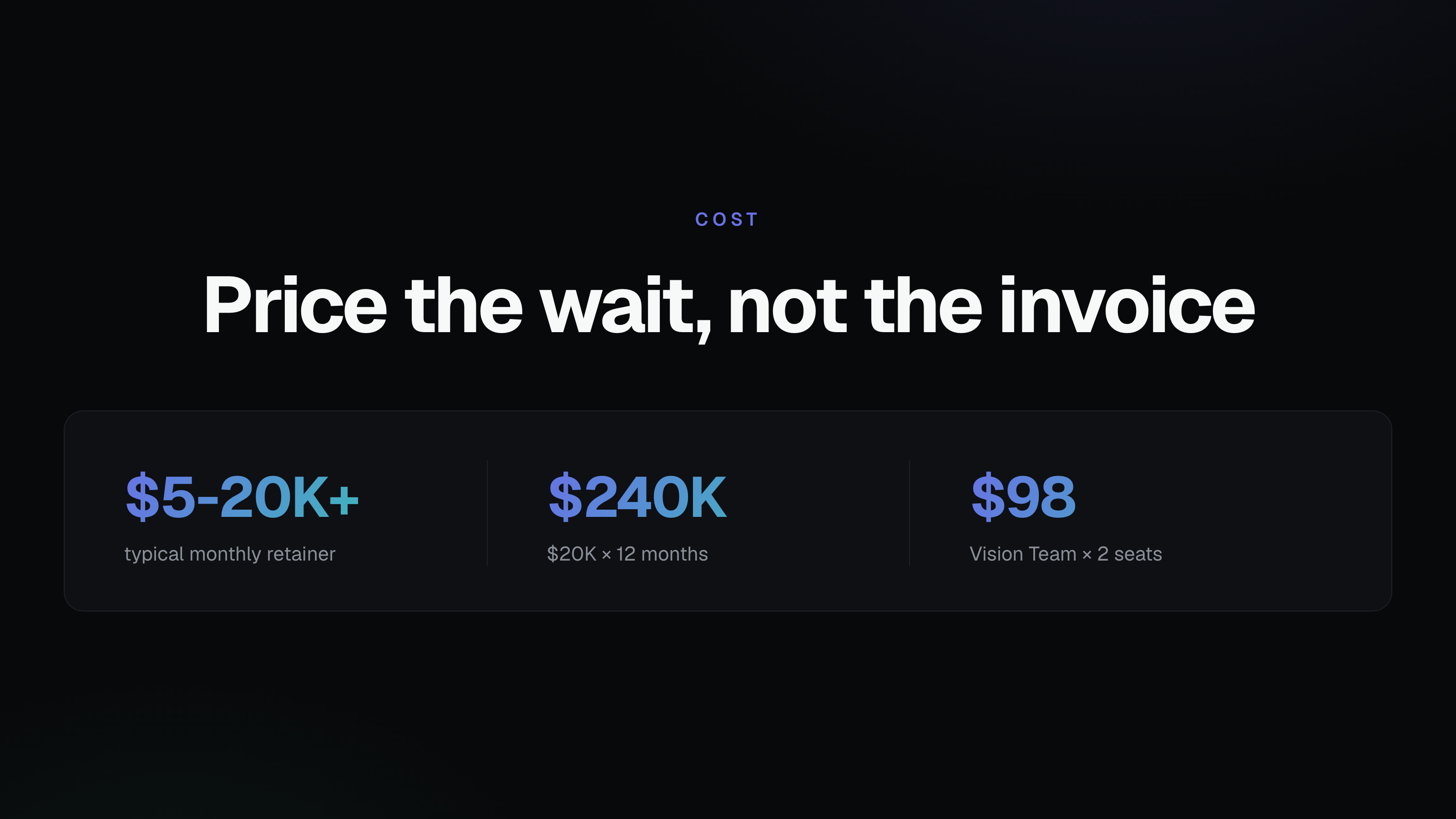
A fractional engineer a few hours a week, or a CTO advisor, should still see sensitive diffs (billing, permissions, data deletion). Vision keeps that review in the same GitHub flow rather than in a private agency Slack. (Some teams sketch this as roughly a $3K part-time reviewer. An old $20K retainer is the wrong comparison for that line item.)
How do the no-technical-team options compare?
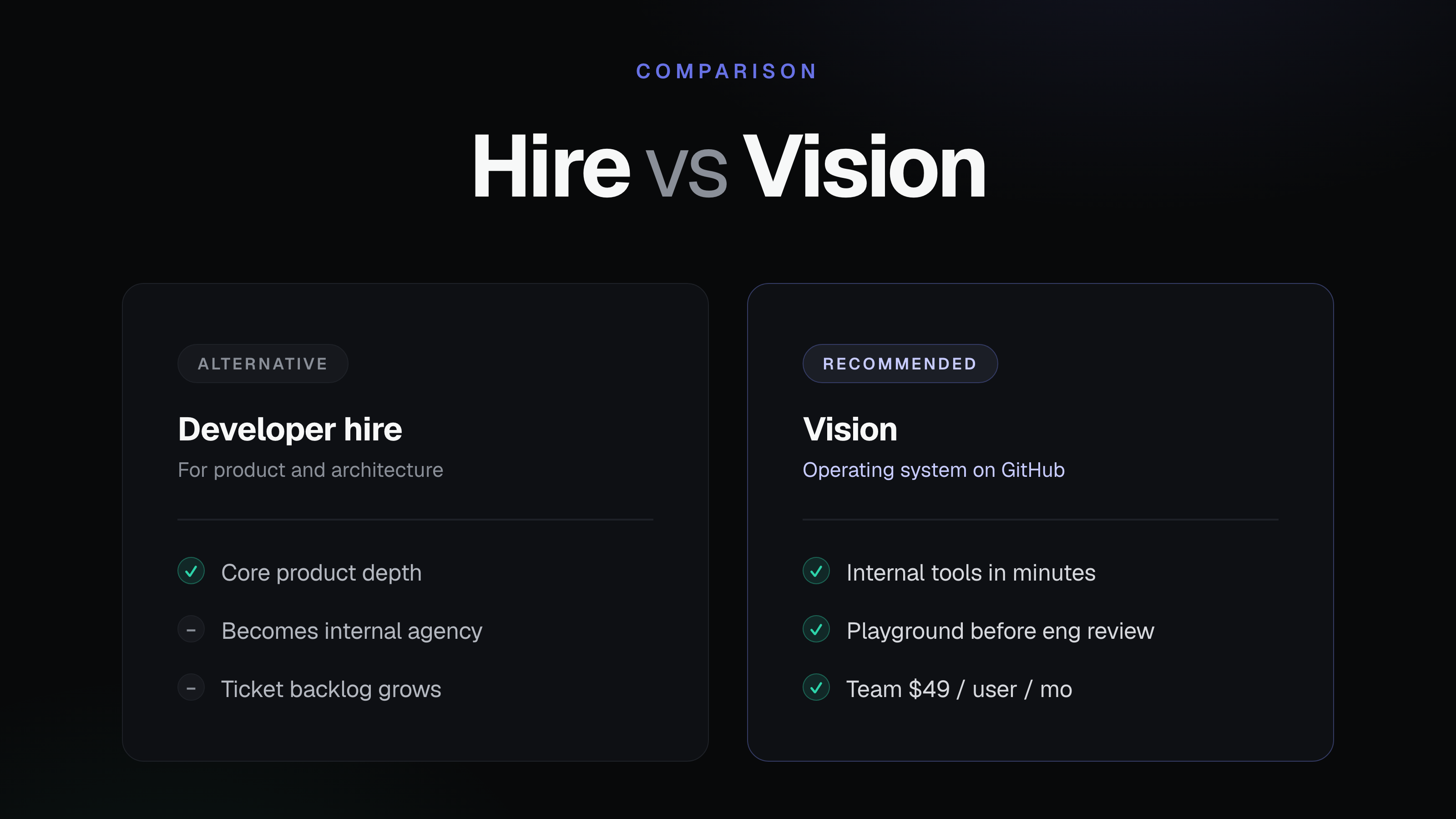
| Approach | Works without engineers day to day | Survives real customers | Typical failure |
|---|---|---|---|
| Vision on your GitHub repo | Yes | Yes, with Playground, Build, guardrails | Skipping promote discipline |
| Greenfield AI app (Lovable, Bolt) | Yes | Weak if it is a shadow system | Rebuilding after launch |
| No-code website builder forever | Yes | Until you need custom logic | Export limits, SEO and CMS lock-in |
| Agency or offshore hire | No. You wait on them. | Yes, if they are good | Retainers and timezone lag |
| Hiring your first developer too early | No | Yes | They become a ticket queue |
How much does this cost if you are not hiring a team?
Vision plans on the live page:
- Starter: $0 / user / month
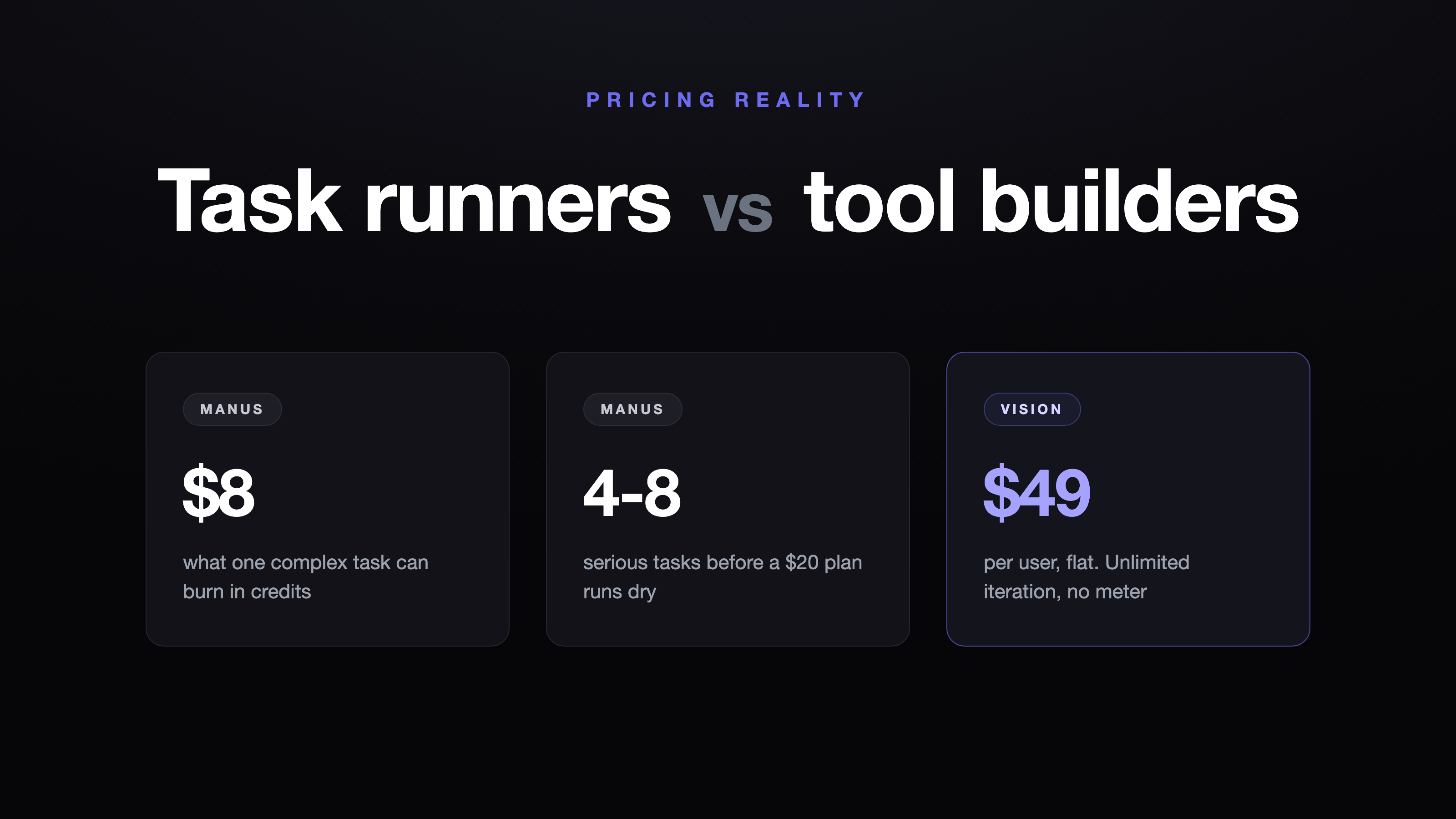
- Team: $49 / user / month (yearly billing saves 20%)
- Enterprise: custom
See pricing. You are not buying "an AI developer personality." You are buying a workspace where the people closest to the work can ship, with a production path a later engineer will not have to throw away.
When is Vision not the answer? What should you not try to build this way?
- Novel cryptography, real-time infrastructure, or a new database engine
- Unreviewed changes to billing logic
- Anything you cannot test in preview
- A deep-tech product with no technical leadership at all
Those still want a specialist. Everything else that is "describe the screen, connect the data, put it behind permissions" is fair game. That is most of a small company's software after v1.
What else do people ask about building software without a technical team?
Can a founder build software with no CTO?
Yes for internal tools and many site rebuilds, if the path to production is gated. For a net-new deep-tech product, you still want technical leadership. Mix the two: Vision for operations software, a specialist for the core bet.
Is vibe coding enough without engineers?
Vibe coding is enough when the tool understands your repo and cannot leapfrog preview. It is not enough when it only makes a demo. See vibe coding for teams.
How do we avoid spaghetti code with no technical team?
Generate reviewable diffs, keep conventions from the existing repo, run typecheck and unit tests, follow DESIGN.md, use conflict detection, and roll back fast. Guardrails are the product. That is the CTO framing even if you do not have a CTO yet.
When should we hire the first engineer?
When the product itself is the constraint, not the admin panel. Hire them to design the system and the sensitive parts. Do not hire them to be a web development agency for your own ops team.
Does Vision charge by tokens?
No token or usage line appears on the live pricing page. Team is $49 per user per month. See pricing.
Ready to build the next tool without opening a hiring req?
If your "technical team" is currently a retainer, a cousin who codes, or nobody, start in Playground on one page or one workflow. Ship it in preview, then decide what still needs a hire.
Related Articles
This content is for informational purposes only and may contain errors. Please contact us to verify important details.