Your team probably knows the feeling. A release is ready, but nobody wants to press the final button because production deploys still depend on tribal knowledge, hand-written runbooks, and one engineer who remembers which environment variable broke staging last quarter. Then the backlog grows, operations teams keep waiting for small internal tools, and every “quick change” turns into a scheduling problem.
That's why deployment automation tools matter far beyond DevOps hygiene. They don't just speed up releases. They define who can ship, what guardrails exist, how fast you can recover, and whether software delivery becomes a repeatable business process instead of a recurring fire drill. The category is also getting bigger. One market projection says the global deployment automation market was expected to surpass deployment automation market analysis on LinkedIn by the end of 2025, with projected continued growth through 2033 as teams standardize CI/CD and reduce human error.
For mid-market and enterprise buyers, a feature checklist isn't enough. You need to know which tools fit repo-centric workflows, which ones handle multi-environment governance well, which ones are strongest for Kubernetes, and which ones can safely involve non-technical operators without bypassing engineering review.
This guide gets to the point. It compares ten leading deployment automation tools through the lens that changes adoption outcomes: security controls, rollback design, preview workflows, approval paths, and role-based access.
Table of Contents

- 1. GitHub Actions
- 2. GitLab CI/CD
- 3. Jenkins
- 4. Argo CD
- 5. Harness
- 6. Octopus Deploy
- 7. Spinnaker
- 8. CircleCI
- 9. AWS CodePipeline + CodeDeploy
- 10. Vision
- Top 10 Deployment Automation Tools Comparison
- Automate Your Deployments, Not Your Decision
1. GitHub Actions

GitHub Actions is the default short list choice for teams already living in GitHub. That sounds obvious, but the practical implication is bigger than convenience. When code review, branch protection, pull requests, secrets, and deployment workflows all sit close together, teams usually enforce release discipline more consistently.
Its strongest pattern is PR-gated deployment automation. A team can model build, test, approval, and promotion logic in YAML, then tie production access to environment rules and reviewer checks. That setup works well for software organizations that want release controls to feel like an extension of normal development instead of a separate delivery platform.
Why teams choose it
The GitHub Actions product page highlights hosted and self-hosted runners, reusable actions, matrix builds, and automation directly inside repositories. For mid-market teams, the marketplace matters almost as much as core features. It reduces the amount of shell scripting and custom glue you have to own.
A few trade-offs stand out:
- Best for repo-native workflows: Teams already standardized on GitHub can gate deployments on PR reviews and status checks without introducing another primary interface.
- Strong for reusable automation: Composite and reusable actions help platform teams standardize deployment logic across many repos.
- Watch cost behavior at scale: Hosted minutes and self-hosted runner economics can become harder to predict once usage spreads across many teams and environments.
Use GitHub Actions when your biggest problem is inconsistent engineering workflow. Don't use it if you need a dedicated release control plane with rich environment orchestration across mixed infrastructure.
GitHub Actions is excellent at making deployment automation feel native. It's less opinionated about release governance than tools built specifically around deployment management, and that distinction matters in larger estates.
2. GitLab CI/CD

GitLab CI/CD appeals to organizations that want fewer system boundaries. Source control, pipelines, security scanning, issues, environments, and approvals can all live in one application. For some enterprises, that's not just tidy architecture. It's a governance strategy.
The bigger story is that GitLab sits inside a market shift toward smarter pipeline behavior. According to Octopus on continuous deployment software trends, AI-assisted deployment recommendations are actively used in 33% of CI/CD pipelines, and anomaly detection in those workflows is described as reaching 89% accuracy. That matters because GitLab is one of the platforms associated with embedded AI-assisted review and reliability features in that trend.
Where GitLab stands out
The GitLab pricing and platform information shows the product's broad delivery model options, including SaaS and self-managed deployment. That flexibility is one reason larger teams keep evaluating GitLab even when they don't need every module.
Its practical strengths are easy to map:
- Unified governance: Protected environments and approval workflows are easier to operationalize when they're next to code and security controls.
- Flexible hosting model: SaaS, dedicated, and self-managed options give security teams room to choose.
- Good fit for central platform teams: Standard components and Auto DevOps patterns help create consistent deployment paths across groups.
For organizations trying to let business teams move faster without bypassing engineering, this often pairs well with tools built for safe internal app creation, such as Vision for teams. GitLab remains the system of record and review. A complementary platform can handle faster app generation while PRs and approvals stay in place.
GitLab is strongest when leadership wants one operating surface. If your company prefers best-of-breed tools for each layer, GitLab may feel broader than necessary.
3. Jenkins

Jenkins remains the tool many teams graduate from, complain about, and keep running anyway. There's a reason. Very few deployment automation tools match its ability to conform to unusual environments, legacy constraints, and bespoke release logic.
That flexibility still matters in 2026 because open-source deployment tooling hasn't faded. One market summary says over 60% of organizations were using open-source tools such as Jenkins, Argo CD, or Spinnaker in CI/CD pipelines as of 2023, with adoption up from 2020. The same summary also says Terraform had a 90% adoption rate among cloud-first enterprises for infrastructure-as-code automation. Both figures point to a broader reality: many organizations still prefer composable, open tooling over locked workflow stacks, as described in deployment automation market research.
Why Jenkins still matters
The Jenkins project site emphasizes pipeline-as-code, extensibility, and broad deployment support. In practice, Jenkins is often the right answer when your infrastructure isn't clean enough for simpler platforms.
Its trade-offs are blunt:
- Huge customization ceiling: Shared libraries and plugins let teams model very specific release processes.
- Air-gapped and on-prem friendly: Jenkins still fits regulated or isolated environments better than many hosted-first tools.
- Operational burden is real: You own controller health, plugin compatibility, access controls, upgrades, and long-term maintenance.
Practical rule: Choose Jenkins only if customization is a strategic requirement, not just a comfort zone.
When non-technical teams start asking for faster delivery, Jenkins can still sit underneath the process, but it usually benefits from a safer front end for request intake and reviewable changes. That's where platforms focused on AI development use cases can reduce engineering queue pressure without replacing the existing deployment backbone.
4. Argo CD

Argo CD is one of the clearest category definitions in this list. It isn't trying to be your CI tool, issue tracker, or all-in-one DevOps suite. It is a Kubernetes delivery system built around Git as the source of truth.
That focus gives it a major advantage in auditability. Desired state lives in Git, drift becomes visible, and rollback is tied to versioned configuration history instead of ad hoc recovery steps. For platform teams managing clusters across environments, that's often more valuable than a broad feature count.
Best fit and trade-offs
The Argo CD project site highlights automated sync, health status, RBAC, and integrations with Helm and Kustomize. Those aren't just product features. Together they create a very specific operating model: Git changes become deployment intent, and the controller reconciles cluster state to match.
That means Argo CD is a strong fit when:
- Kubernetes is the center of gravity: If most production systems already run on Kubernetes, Argo CD can simplify deployment standardization.
- GitOps discipline is a goal: Teams willing to adopt repository structure and declarative practices get strong traceability.
- Multi-cluster visibility matters: A single view of application health across environments reduces manual cluster checking.
Its limitation is just as clear. Argo CD won't solve general CI orchestration or non-Kubernetes deployment problems. If your estate includes VMs, legacy apps, or mixed operational tasks, you'll probably need another layer beside it.
Argo CD is less a universal answer than a high-conviction answer. For Kubernetes-first organizations, that's often exactly what makes it valuable.
5. Harness
A common enterprise release scenario looks like this: the deployment succeeded technically, but error rates rise, customer-facing latency worsens, and the rollback decision takes too long because each team is looking at different signals. Harness is built for that failure mode. Its strongest case is not basic pipeline automation. It is reducing the time between a bad release and a safe response.
That focus matters more in regulated and high-availability environments than feature checklists usually suggest. Teams in finance, healthcare, large-scale SaaS, and retail often need more than CI/CD speed. They need approval controls, observable rollout behavior, and rollback paths that do not depend on improvised coordination during an incident.
Where Harness stands out
The Harness pricing page shows a platform that spans CI, CD, GitOps, IaC, and security. For mid-market and enterprise buyers, the practical question is whether that breadth reduces tool sprawl or only shifts it into one vendor contract. The answer depends on operating model.
Harness tends to fit best when teams value these criteria:
- Rollback and verification: Progressive delivery and automated verification make sense for organizations where release quality matters as much as release frequency.
- Governance and RBAC: Standardized templates, approval flows, and policy controls help platform teams enforce deployment rules across many services and teams.
- Preview and change safety: Teams shipping frequently can test release behavior in stages instead of treating production as the first real validation point.
- Platform consistency: Organizations with multiple delivery patterns can use Harness as a shared control plane rather than asking each team to assemble its own stack.
The trade-off is cost and complexity. Harness is easier to justify when deployment failure has visible financial or operational consequences, or when internal platform teams already have the mandate to standardize tooling. Smaller engineering groups with simple release paths may find that lighter CI/CD products cover the same baseline needs with less overhead.
There is also an important organizational angle. Harness helps engineering leaders control how software reaches production. Vision for CTOs addresses a different bottleneck by letting non-technical teams produce useful internal tools and changes inside a governed framework. For enterprises, that pairing is more interesting than it first appears: Harness can protect production delivery, while Vision can expand who is able to contribute without weakening review, RBAC, or deployment safety.
Harness is rarely the default choice for teams optimizing for price. It is a stronger choice for teams optimizing for controlled releases, auditability, and recovery speed.
6. Octopus Deploy

Octopus Deploy has a different personality from repo-native CI systems. It feels like release management software built by people who expect environments, approvals, operations tasks, and deployment coordination to stay messy longer than teams hope.
That makes it especially attractive in mixed estates. If you're deploying to Kubernetes, VMs, Windows servers, Linux hosts, and operational runbooks at the same time, Octopus often feels more natural than trying to force everything into a pure CI interface.
Where Octopus is strongest
The Octopus Deploy pricing overview and platform pages emphasize release orchestration, approvals, runbooks, and broad target support. In practice, Octopus shines when deployment is only part of the operational workflow.
Its strongest patterns include:
- Environment promotion: Clear progression across dev, test, staging, and production with visible approvals.
- Operational automation: Runbooks make it useful even when no code release is happening.
- Granular control surfaces: Variable scoping, release snapshots, and role-based controls help in larger teams.
One of the most important market-level observations tied to Octopus content isn't about Octopus alone. There's a documented gap in practical guidance for letting non-technical teams trigger production changes safely while engineers stay in the loop through pull requests and progressive permissions, as discussed in Octopus analysis of deployment automation tools and governance gaps.
The real challenge isn't whether a tool supports approvals. It's whether the approval model is usable when the builder isn't an engineer.
That's where Octopus is strong on governance mechanics, but not necessarily the full answer for non-technical builders. It handles release control well. It doesn't by itself solve who creates the software change safely in the first place.
7. Spinnaker

Spinnaker is for organizations with deployment patterns serious enough that lightweight tooling starts to look irresponsible. Blue-green rollouts, canary analysis, multi-cloud delivery, approval gates, and high-control orchestration are its home territory.
The trade-off is obvious the moment you look at it. Spinnaker asks more from the team operating it. That means smaller companies often overbuy it, while large enterprises sometimes find it's one of the few tools that matches the complexity they already have.
When the complexity is worth it
The Spinnaker project site makes its orientation clear: elaborate delivery strategies across cloud platforms and Kubernetes. It's not trying to be minimal.
Spinnaker tends to be the right fit when:
- Deployments carry high blast radius: Canary and staged rollout patterns justify the additional control plane.
- Multi-cloud isn't optional: Teams need one orchestration layer above provider-specific tools.
- Manual judgment remains important: Approval steps and controlled pipeline flow still matter in risk-heavy releases.
Its downside isn't lack of capability. It's organizational weight. Spinnaker needs operators who understand both the platform and the deployment strategies it enables. Without that, teams get complexity without confidence.
For enterprises with strong platform engineering functions, that trade can be worth it. For mid-market teams, the better answer is often a simpler CI/CD base plus targeted governance layers.
8. CircleCI

CircleCI's appeal is practical. Teams choose it when they want fast hosted execution, flexible compute choices, and enough deployment structure to avoid cobbling together every step themselves. It often wins less on ideology than on day-to-day developer experience.
That matters for organizations shipping across different stacks. macOS, Windows, Linux, ARM, Docker, and specialized resource classes make CircleCI useful when one platform team supports many product teams with different runtime needs.
Why some teams prefer it
The CircleCI pricing page reflects its hosted-first model and resource-based operational choices. The platform also gives teams reusable “orbs,” deployment interfaces, and self-hosted options for regulated scenarios.
Why buyers keep it in the mix:
- Good execution flexibility: Teams can tune runtime environments to the workload instead of standardizing on one runner type.
- Solid deployment visibility: Deploy markers and environment-aware workflows help connect pipelines to actual release activity.
- Strong fit for mixed engineering orgs: It handles mobile, backend, and infrastructure-heavy workloads in one system.
CircleCI's main caution is financial predictability. Credit-based usage models can work well, but only if someone actively monitors how teams consume compute and parallelism.
Hosted convenience is only a bargain if your org has basic pipeline hygiene. Otherwise you'll automate waste at scale.
CircleCI is best for teams that want speed and flexibility from the CI/CD engine itself, not necessarily a heavyweight release management layer.
9. AWS CodePipeline + CodeDeploy

AWS CodePipeline and CodeDeploy are easiest to evaluate with one question: how AWS-native is your operating model? If the answer is “very,” this pair becomes much more attractive than it first appears.
That's because the value isn't just deployment automation. It's alignment with IAM, CloudWatch, S3, CloudFormation, Lambda, ECS, and VPC-based operational patterns. Teams don't have to build as much connective tissue between delivery and the rest of the platform.
The AWS-first advantage
The AWS CodePipeline pricing page shows managed pipeline options, and AWS's broader tooling supports blue-green and in-place deployment paths through CodeDeploy. For AWS-centric teams, the operational model is often straightforward enough that “boring” becomes a feature.
Its main strengths are clear:
- Native identity and access control: IAM can govern who can trigger and manage deployment actions.
- Strong fit for ECS and Lambda workflows: Blue-green patterns are easier when the target platform and deployment service already understand each other.
- Managed service posture: Teams avoid maintaining separate deployment infrastructure.
The limitations are equally important. Portability drops as your workflow gets more AWS-specific. If you expect to move significant workloads across clouds or keep a broad hybrid estate long-term, a cloud-neutral layer may age better.
For teams already standardized on AWS, though, CodePipeline plus CodeDeploy can be the most operationally coherent choice on the list.
10. Vision
Vision belongs in this list for a different reason than the others. It isn't just another CI/CD engine or release orchestrator. It changes who can safely participate in software delivery.
Most deployment automation tools assume the builder is technical. That assumption creates a bottleneck in mid-market and enterprise teams. Operations managers, support leaders, business analysts, and product owners often know exactly what internal tool or workflow they need, but they still have to wait for engineering to translate the request into code. Vision addresses that gap by connecting to the existing codebase, generating reviewable changes, and sending them through the normal engineering workflow.
Why Vision changes the buying conversation
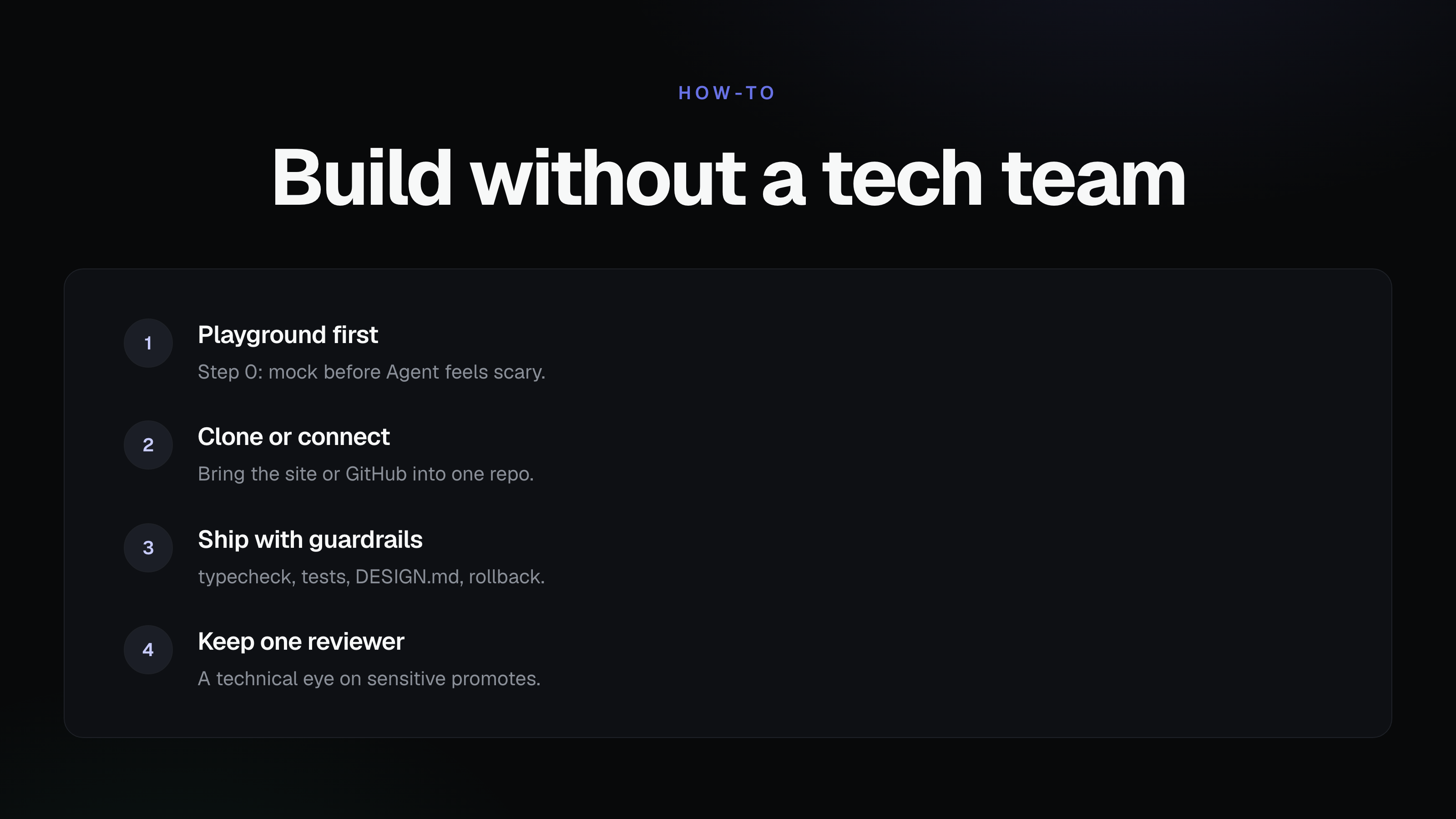
The Vision platform is built around a simple but unusually important model. Non-technical teams can describe what they need in natural language, Vision works against actual repository and stack conventions, and engineers still approve changes through pull requests. Every edit gets a live preview, production promotion is explicit, and rollback is built into the flow.
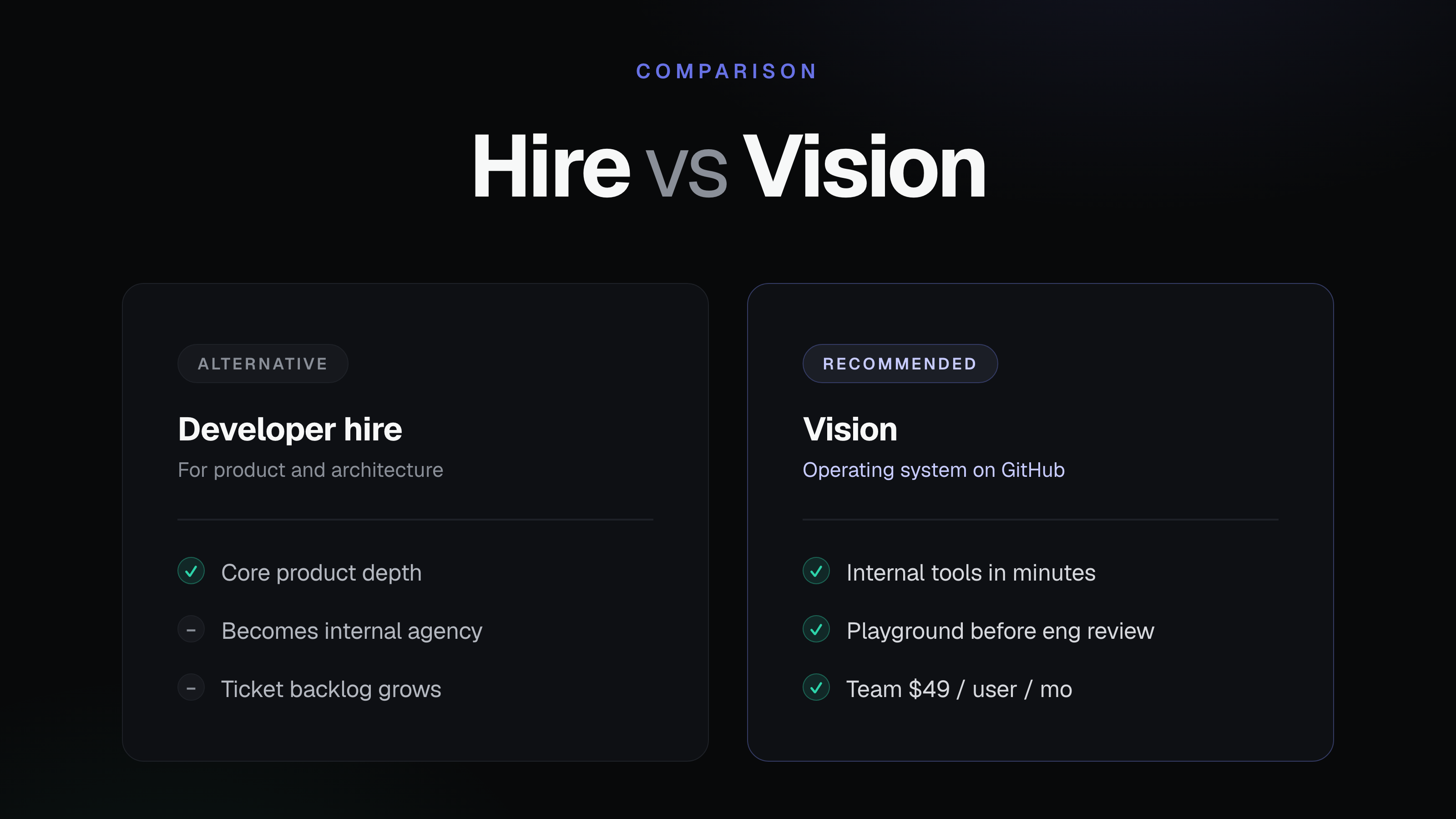
That makes Vision complementary to many of the tools above rather than a direct replacement. GitHub Actions, GitLab, Jenkins, Harness, or Octopus can remain the deployment backbone. Vision changes the upstream part of the system by letting more people create valid, reviewable software changes without bypassing governance.
Its strongest differentiators are practical:
- Built for existing codebases: It extends live repositories instead of generating isolated apps that become side systems.
- Preview-first workflow: Teams can inspect changes before promotion, which matters when non-engineers are involved.
- Role-based access with scoped permissions: Access can start narrow and expand as trust is earned.
- Engineer oversight stays intact: Pull requests remain the control point, so software quality and security review don't disappear.
- Enterprise identity and governance options: SSO, SCIM, audit logs, and compliance-oriented controls support larger rollouts.
This is the most interesting tool on the list if your deployment problem is an organizational problem. Many companies don't just need faster pipelines. They need a safe way for business teams to ship low-risk internal software without living in the engineering backlog.
Vision does have boundaries. It isn't a substitute for sound repository structure, code ownership, or disciplined review. If engineering governance is weak, faster generation can expose that weakness sooner.
Still, Vision points to an important conclusion. The next phase of deployment automation won't just optimize pipelines. It will widen participation while preserving approval, rollback, and auditability. For companies trying to enable internal software delivery without creating shadow IT, that's a meaningful shift.
Top 10 Deployment Automation Tools Comparison
| Platform | Core features | UX & Safety (★) | Value & Pricing (💰) | Target audience (👥) | Unique selling points (✨) |
|---|---|---|---|---|---|
| GitHub Actions | Workflow-as-code (YAML), hosted/self-hosted runners, marketplace | ★★★★☆, strong PR gates & env protections | 💰 Included with GitHub; usage minutes can add cost | 👥 Dev teams on GitHub | ✨ Deep repo integration; huge action ecosystem |
| GitLab CI/CD | Built-in pipelines, runners, environments, Auto DevOps | ★★★★☆, integrated approvals & governance | 💰 Per-user/credits; SaaS or self-managed tiers | 👥 Teams wanting single-app DevOps | ✨ Single app for code, issues, security, CI/CD |
| Jenkins | Declarative/scripted pipelines, 2000+ plugins, on‑prem support | ★★★☆☆, powerful but infra & maintenance heavy | 💰 Open-source (no license); infra costs apply | 👥 Teams needing extreme customization/on‑prem | ✨ Unlimited extensibility via plugins |
| Argo CD | GitOps reconciliation, app health UI, multi-cluster support | ★★★★☆, auditability & drift detection | 💰 OSS; operational cost for K8s infra | 👥 Kubernetes-native teams | ✨ GitOps-first, multi-cluster sync & rollback |
| Harness | Progressive delivery, automated verification & rollback | ★★★★☆, deployment safety & verification | 💰 Commercial, custom quotes / HSUs | 👥 Enterprises prioritizing safe rollouts | ✨ Built-in verification, policy-as-code |
| Octopus Deploy | Release snapshots, runbooks, agents for VMs/K8s | ★★★★☆, strong release orchestration UX | 💰 Free tier; licensing scales by projects/targets | 👥 Teams needing CD + day‑2 ops | ✨ Runbooks, tenant support, clear upgrade path |
| Spinnaker | Advanced strategies (canary/blue-green), pipeline orchestration | ★★★★☆, excellent for complex, high-risk deploys | 💰 OSS; heavier ops overhead at scale | 👥 Large enterprises & multi-cloud teams | ✨ Sophisticated orchestration & multi-cloud safety |
| CircleCI | Cloud-first CI/CD, wide executor options (macOS, GPUs) | ★★★★☆, mature deploy UX & resource tuning | 💰 Credit-based pricing; monitor to avoid surprises | 👥 Teams needing macOS/GPU or hosted scale | ✨ Fine-grained resource classes & orbs |
| AWS CodePipeline + CodeDeploy | Managed pipelines & deployments for AWS targets | ★★★★☆, predictable within AWS, IAM controls | 💰 V1/V2 pricing models; cost-effective for AWS-first | 👥 AWS-centric engineering teams | ✨ Tight integration with AWS services & IAM |
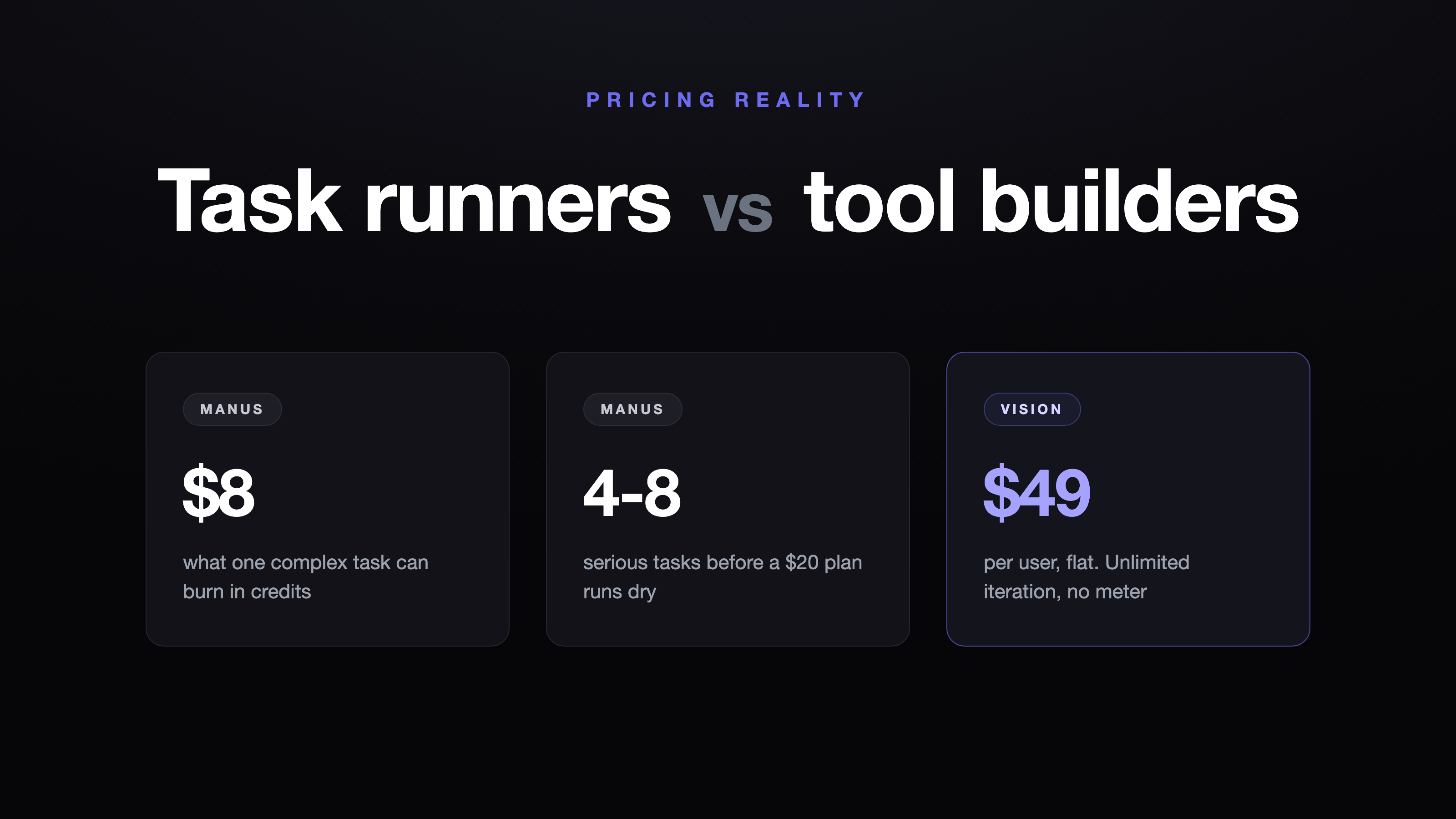
| Vision 🏆 | AI-assisted repo-tied codegen, live previews, one‑click rollback, RBAC | ★★★★★, reviewable code, live previews, PR-based safety | 💰 Starter free; Team $49/user/mo; Enterprise custom | 👥 Ops, PMs, business teams + eng/security oversight | ✨ Nontechnical builders ship via repo-integrated AI; org-level GitHub connect; progressive trust |
Automate Your Deployments, Not Your Decision
The right deployment automation tool depends less on category labels and more on where risk sits in your organization. If your main pain is inconsistent engineering workflow, GitHub Actions or GitLab CI/CD may be enough. If you operate across legacy servers, Kubernetes, and operational runbooks, Octopus Deploy often makes more sense. If your estate is Kubernetes-first, Argo CD gives you a cleaner operating model than broader platforms. If release safety is the central concern, Harness and Spinnaker deserve serious attention.
That's the obvious part. The less obvious part is that many teams buy the wrong tool because they frame the problem too narrowly. They think they're selecting a pipeline engine, when they're really selecting a governance model. Who can trigger a release? Who can review changes? How do previews work? What does rollback look like under pressure? Which environments are protected? How visible is drift between intent and production state? Those questions shape delivery speed more than any single YAML syntax or plugin library.
Mid-market and enterprise teams should test tools against a live scenario, not a polished demo. Take one real service or internal application. Model a staging-to-production release. Add approvals. Simulate a bad deployment. Check how quickly operators can identify what changed, stop promotion, and recover. Then test the human side. See whether a platform engineer, product manager, and operations lead can all understand the path to production without side-channel knowledge.
One more buying mistake is increasingly common. Teams optimize deployment for engineers alone while a larger bottleneck builds elsewhere. Operations, support, success, and business teams still wait on simple internal tools, workflow changes, and reporting interfaces because they can't safely contribute code. That's why a platform like Vision deserves a place in the deployment automation conversation. It doesn't replace your CI/CD foundation. It complements it by turning software delivery into a broader organizational capability while preserving review, previews, explicit promotion, and rollback.
The strongest deployment stack in 2026 will usually combine two ideas. First, choose a core tool that fits your infrastructure and governance needs. Second, decide whether software creation itself should remain limited to engineers. If the answer is no, you'll need more than pipeline automation. You'll need a safe production framework for non-technical builders as well.
A good deployment system should make releases less dramatic, ownership clearer, and recovery faster. If a tool can't do that in your real environment, it's not the right automation. It's just more moving parts.
If your biggest delivery bottleneck isn't the pipeline but the queue in front of engineering, Vision is worth a close look. It gives operations, support, product, and business teams a way to build against existing codebases, preview every change, and ship through normal pull request review with explicit promotion and rollback. That's a practical path to faster internal software delivery without giving up control.
Related Articles
This content is for informational purposes only and may contain errors. Please contact us to verify important details.