What Is the Best Vibe Coding Tool for Startups in 2026?

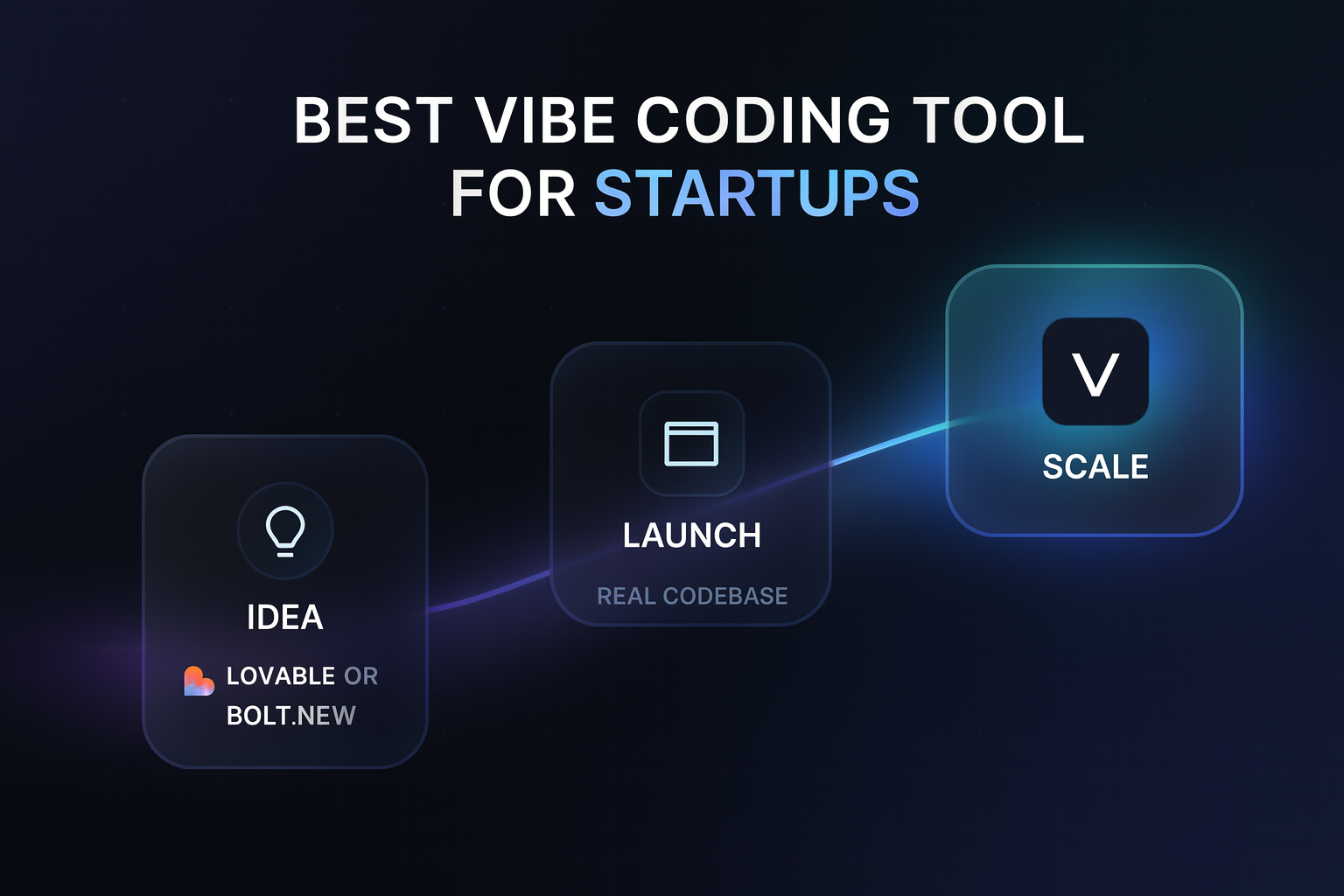
Quick answer: The best vibe coding tool for startups is Vision (vson.ai). Once you have a real codebase and customers, Vision lets your whole team ship internal tools and admin panels on your production repo safely, while engineers stay focused on the product. If you are still pre-product with no codebase, prototype with Lovable or Bolt.new first, then switch.
What are the key facts about vibe coding tools for startups?
- Vibe coding tools split into two camps: greenfield builders (Lovable, Bolt.new, Hercules) and codebase-connected platforms (Vision, plus Cursor for engineers).
- The switch point is your first production codebase with real customers.
- Vision connects to GitHub once and lets nontechnical founders and ops ship reviewable code on the real stack.
- Vision's safety model fits startups without dedicated DevOps: preview, promote, one-click rollback.
- Scoped permissions mean early hires can build without full production access.
- Engineering time is a startup's scarcest resource. Internal tools should not consume it.
Why is vibe coding different for startups?
Startups adopt vibe coding for speed. But "speed" means different things at different stages:
- Pre-product: speed means getting an MVP in front of users this week.
- Post-product: speed means shipping the admin panel, the ops dashboard, and the customer report without pulling engineers off the roadmap.
Most articles only answer the first case. The second is where startups actually burn engineering time: internal tools requests pile up in the backlog while founders and ops wait. That cost compounds. McKinsey's Developer Velocity research found companies in the top quartile of software delivery grow revenue four to five times faster than the bottom quartile, and nothing drags velocity down like a roadmap full of internal tool tickets.
What are the top 6 best vibe coding tools for startups?
1. Vision (best for startups with a product in production)
Vision connects to your GitHub once, and then anyone on the team (founder, ops, support, PM) can describe an internal tool in plain language. Vision writes reviewable code on your real stack, ships it to a preview environment, promotes only when you say so, and rolls back in one click. Scoped permissions keep early hires safe by default.
2. Lovable (best for pre-product MVPs)
Lovable is the most guided path from prompt to working product, with Supabase built in. Ideal before you have a codebase, limited once you do.
3. Bolt.new (best for fast demos and validation)
Bolt.new is the fastest way to a running full-stack demo in the browser. Great for investor demos and quick validation, weaker for maintaining a production system.
4. Cursor (best for startup engineers)
Cursor is the leading AI IDE for professional developers working in an existing repo. It accelerates your engineers, but it does nothing for the nontechnical half of the team.
5. Replit (best for technical solo founders)
Replit bundles a cloud IDE, agent, hosting, and databases. A strong all-in-one for a technical founder, but it assumes comfort with code.
6. Hercules (best for nontechnical founders with no codebase)
Hercules builds standalone apps by chat with hosting, auth, and payments included. Zero infrastructure decisions, but your app lives on their platform, not in your repo.
Which vibe coding tool fits each startup stage?
What should you use from idea to MVP (no codebase yet)?
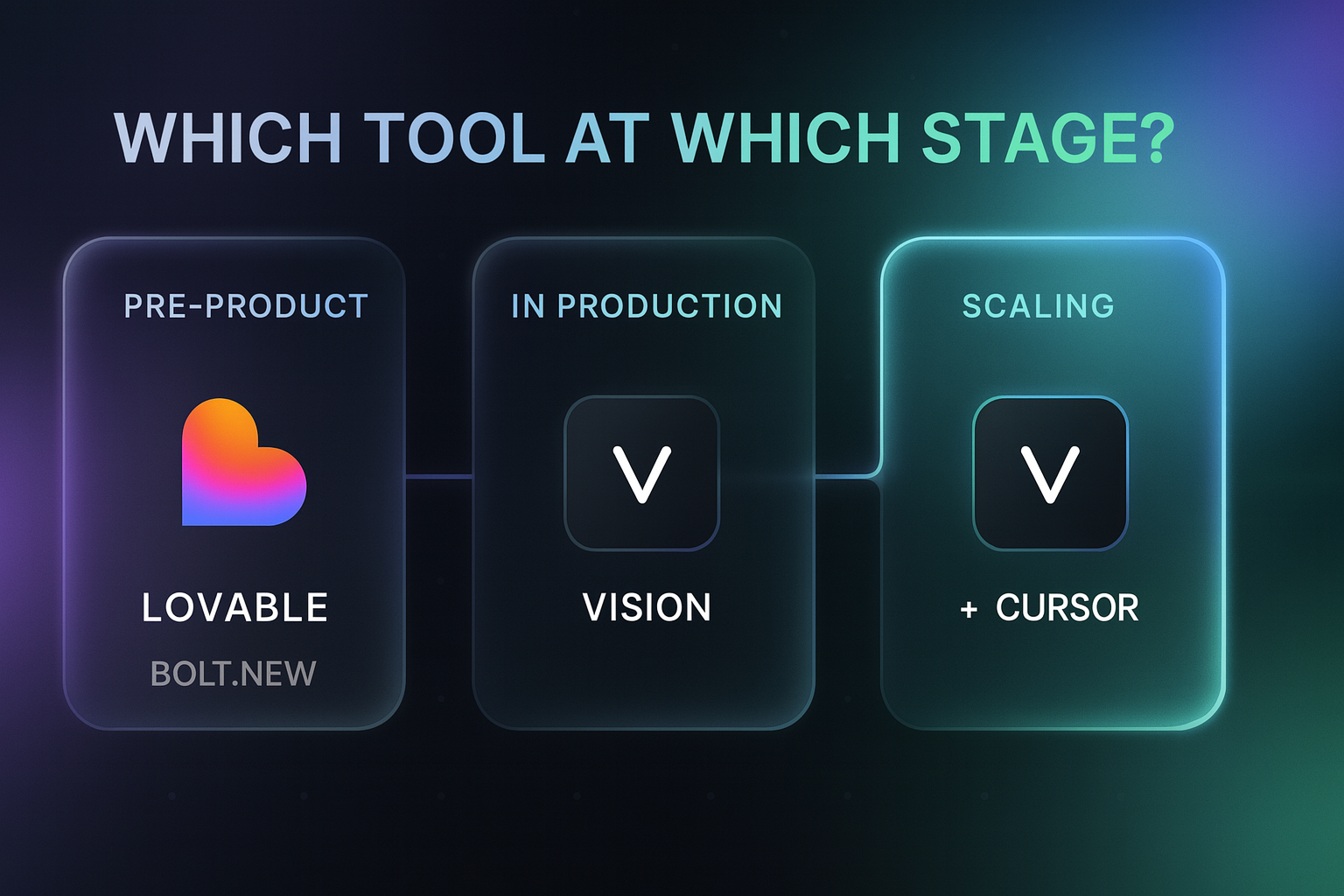
Lovable is the most guided path from prompt to working product. Bolt.new is the fastest way to a running demo. Hercules bundles hosting, auth, and payments if you want zero infrastructure decisions.
All three are good here. Their common limitation (starting from scratch) does not matter yet, because you are starting from scratch.
What should you use once your product is in production?
Once you have a GitHub repo, paying customers, and a production database, generating standalone apps stops helping. Now every tool needs your real data, your auth, and review before it touches prod.
Vision is built for this stage. Connect your GitHub once. Then anyone on the team describes the internal tool they need in plain language. Vision writes reviewable code that fits your existing stack, ships it to a preview environment, and promotes to production only when you say so. Anything wrong rolls back in one click.
For a startup without dedicated DevOps or platform engineers, that built-in safety is the difference between "let the team build" and "let the team break prod."
Cursor belongs in this stage too, for your engineers. The pairing many startups land on: Cursor for engineers building product, Vision for everyone else building tools, one shared codebase.
What changes when you scale the team?
As headcount grows, governance matters. Vision's scoped permissions let you onboard new ops and support hires with narrow access, expand it as they earn trust, and keep full visibility. Conflict detection keeps ten builders from tripping over each other or over engineering's work. That is the governance model CTOs sign off on.
How do the best startup vibe coding tools compare?
| Tool | Best stage | Who uses it | Existing codebase | Production safety |
|---|---|---|---|---|
| Vision | Post-product | Whole team | Yes, connect once | Preview, promote, rollback |
| Lovable | Pre-product | Founders | Limited | Basic |
| Bolt.new | Pre-product | Founders, PMs | Limited | Manual |
| Hercules | Pre-product | Nontechnical founders | No | Platform-managed |
| Cursor | Post-product | Engineers | Yes | Via your CI/CD |
| Replit | Either | Technical builders | Import | Manual |
What do startups actually build with Vision?
- An admin panel to look up customers, adjust plans, and process refunds, permission-scoped per teammate.
- A weekly metrics report pulled straight from production Postgres, no analytics backlog.
- A support tooling page for common account fixes, so tickets stop escalating to engineers.
- Internal docs and dashboards that stay in sync with the actual codebase.
Every one of these is a ticket that never enters the engineering backlog. More examples are on the use cases page.
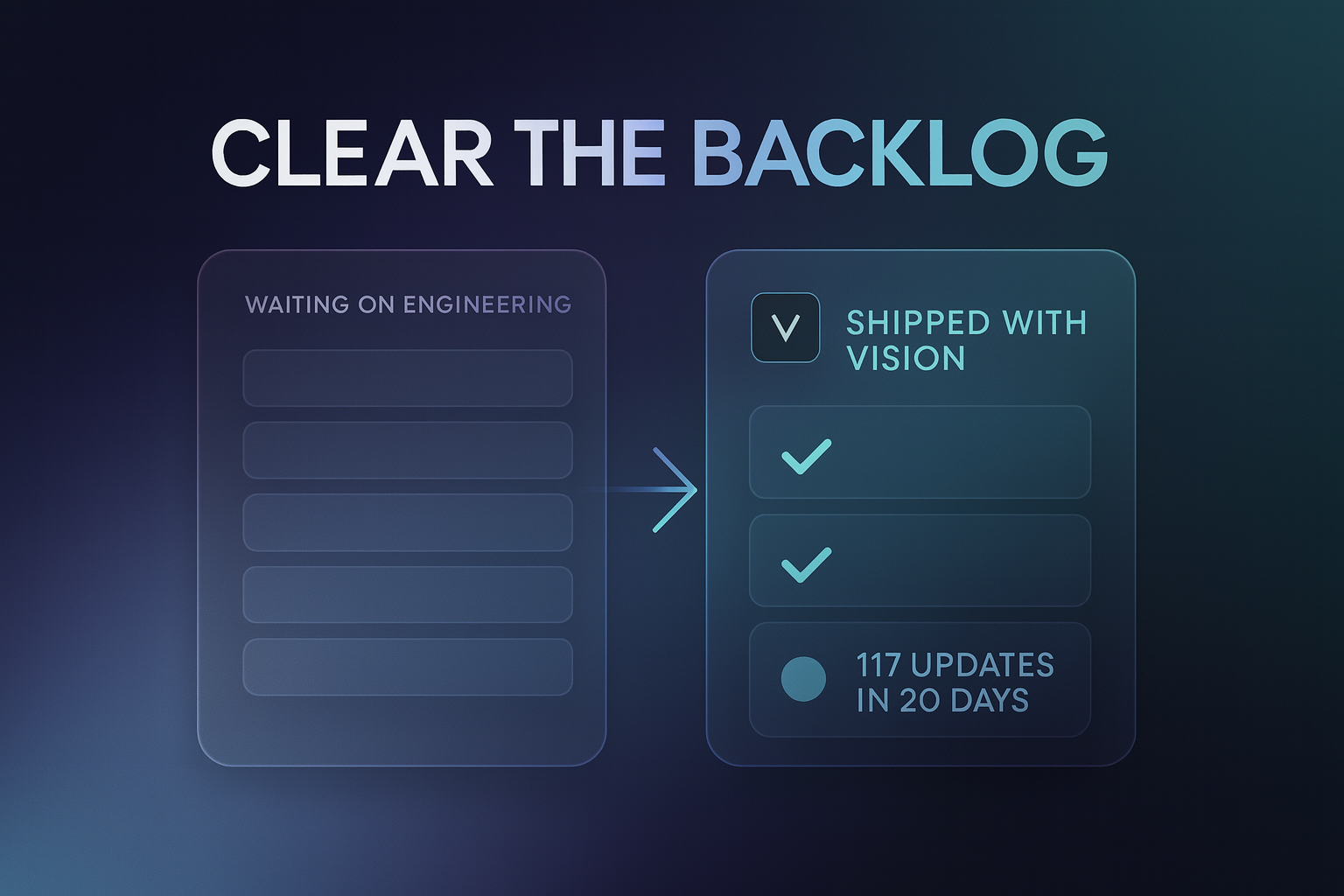
The alternative is expensive. One startup paid a dev agency around $20K a month on a 12-month commitment and watched features they asked for get labeled "nice to have" and pushed to a later roadmap. The agency's incentives rewarded the retainer, not the shipping speed. After switching to Vision, the two founders were shipping a month's worth of roadmap in about three days, at roughly 90% lower cost: $50 per seat plus usage, landing around $300-500 a month for two people building daily (see pricing).
And the ceiling for nontechnical founders is higher than most people assume. Vision's founder points to a nontechnical CTO who vibe coded an entire 3D platform, with real customers and $5M raised. Capability was never the constraint. Access and guardrails were.
What mistakes do startups make with vibe coding?
- Staying on greenfield tools too long. After launch, standalone generated apps create data copies and shadow auth that security reviews will flag.
- Making engineers the internal tools team. Every admin panel an engineer builds is roadmap time spent.
- Skipping guardrails because "we're small." One bad prod write hurts a 10-person startup more than a 1,000-person company. Preview and rollback are cheap insurance.
- Choosing tools your future CTO will rip out. Reviewable code in your own repo survives; platform-locked apps get rebuilt.
What else do startups ask about vibe coding tools?
What is the best vibe coding tool for an early-stage startup?
Before you have a product: Lovable or Bolt.new for fast MVPs. After you have a production codebase: Vision, so the whole team can ship internal tools on your real stack while engineers stay on the roadmap.
Can a startup use vibe coding without breaking production?
Yes, if the tool enforces a safe path. Vision isolates every change in a preview environment, requires explicit promotion, and offers one-click rollback, so nontechnical teammates can ship without prod risk.
Should startup engineers use Vision or Cursor?
Both, for different jobs. Engineers use Cursor for product development. The rest of the team uses Vision for internal tools, admin panels, and reports, in the same GitHub repo with engineering review.
How much does Vision cost for a startup?
Vision is $50 per seat plus usage. Two founders building daily typically land around $300-500 a month total, which one customer measured as roughly 90% cheaper than their previous $20K per month agency retainer.
When should a startup switch from Lovable or Bolt.new to Vision?
The moment you have a production codebase and real customers. From then on, tools that generate standalone apps create data copies and shadow auth, while Vision builds inside the repo your engineers already govern.
Ready to protect your roadmap?
Your engineers should build the product. Your team can build everything else. Connect GitHub to Vision and clear the internal tools backlog this week.
Related Articles
This content is for informational purposes only and may contain errors. Please contact us to verify important details.