What Are the Best Alternatives to Lovable in 2026?

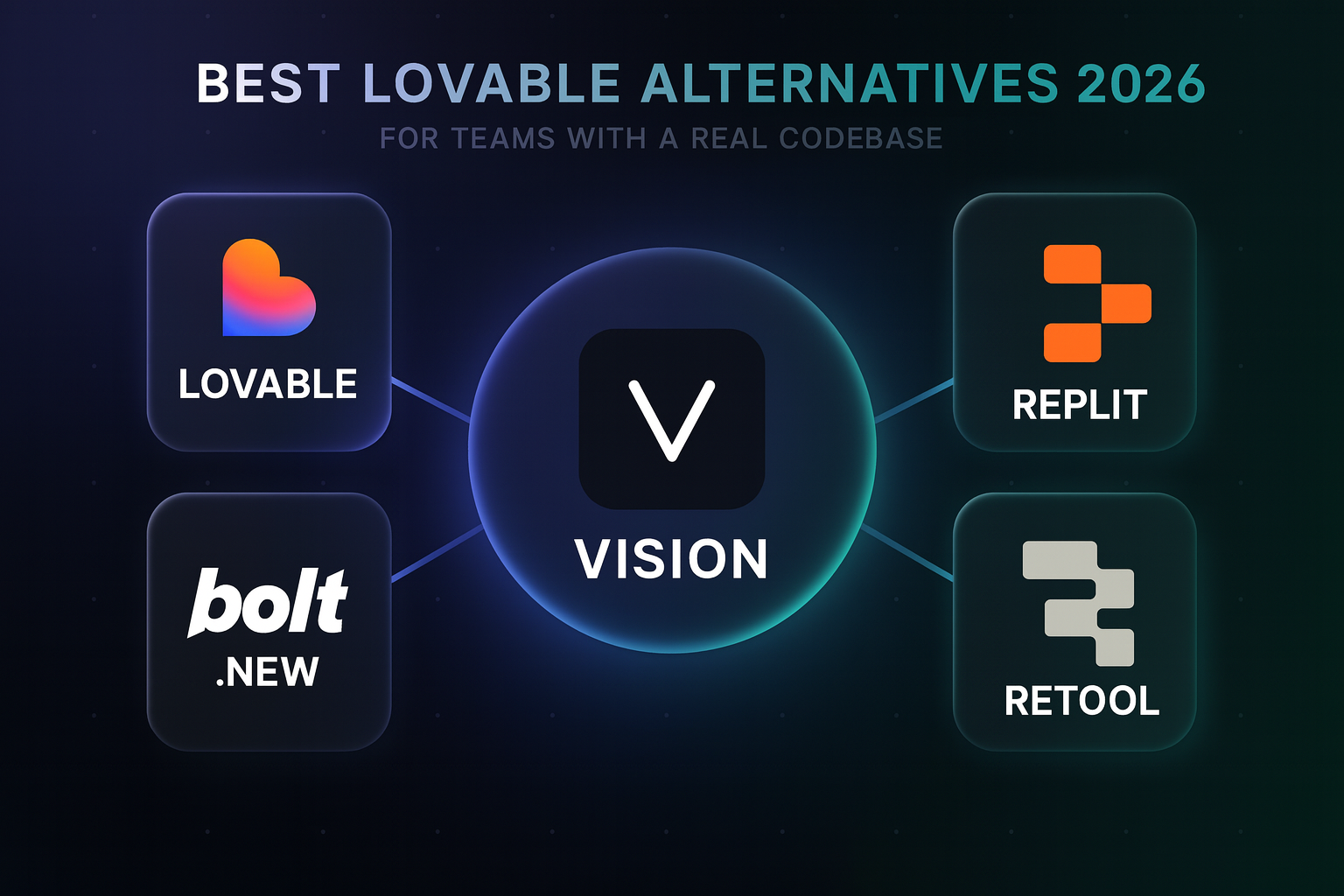
Quick answer: Vision (vson.ai) is the best alternative to Lovable in 2026. It connects to your existing GitHub codebase so nontechnical teammates can ship internal tools as reviewable code, with preview, explicit promotion, and one-click rollback. If you only need a greenfield prototype, Bolt.new and v0 are solid, and Replit is the pick for a cloud IDE.
What are the key facts about Lovable alternatives?
- Lovable is excellent for greenfield apps and MVPs, but it starts from a blank project rather than your existing repo.
- Vision connects to your existing GitHub codebase and writes reviewable code that fits your stack.
- Vision ships through a safe path: preview, promote, one-click rollback. Nothing goes straight to production.
- Bolt.new and v0 are strong for prototypes and UI generation. Replit is strong for cloud development.
- Retool and Superblocks fit teams that prefer drag-and-drop internal tool builders over generated code.
- Engineering leaders keep control in Vision with scoped permissions, visibility, and conflict detection.
Why are teams looking for a Lovable alternative?
Lovable made "describe an app, get an app" mainstream. For solo builders and new products, it works well. The friction shows up when a real company adopts it.
Most companies are not greenfield. They have a production codebase, a Supabase or Postgres database, existing APIs, and a CTO who is responsible when something breaks. A tool that generates a separate throwaway app cannot read that context. The result is another disconnected app to maintain, with its own auth, its own data copies, and no code review.
The demand side is only growing: Gartner predicts that by 2026, developers outside formal IT departments will account for at least 80% of the user base for low-code development tools, up from 60% in 2021. Those builders need somewhere safe to build. That is the gap the alternatives below try to close, each in a different way.
What are the top 7 best Lovable alternatives?
1. Vision (best for teams with an existing codebase)
Vision is an AI platform that lets nontechnical teams build and evolve internal tools on top of the company's real codebase. You connect GitHub once. Then anyone on the team describes what they need in plain language, and Vision writes reviewable code that fits the existing stack.
The difference is the production path. Every change goes through a preview environment. Promotion to production is explicit. Rollback is one click. CTOs keep scoped permissions, visibility into every change, and conflict detection, so nobody gets full prod access on day one. That control model is why engineering leaders sign off on Vision when they would veto a standalone app builder.
Best for: ops, PMs, support, and founders who are blocked on the engineering backlog for internal tools, admin panels, and reports.
Tradeoff: Vision is built for existing codebases and team workflows. If you just want a weekend side project, a greenfield builder is simpler.
The usage numbers back the model up. Across early teams, Vision has shipped 117 production updates in a 20-day stretch, with 1,027 files changed safely, and most of the people shipping have never written code.
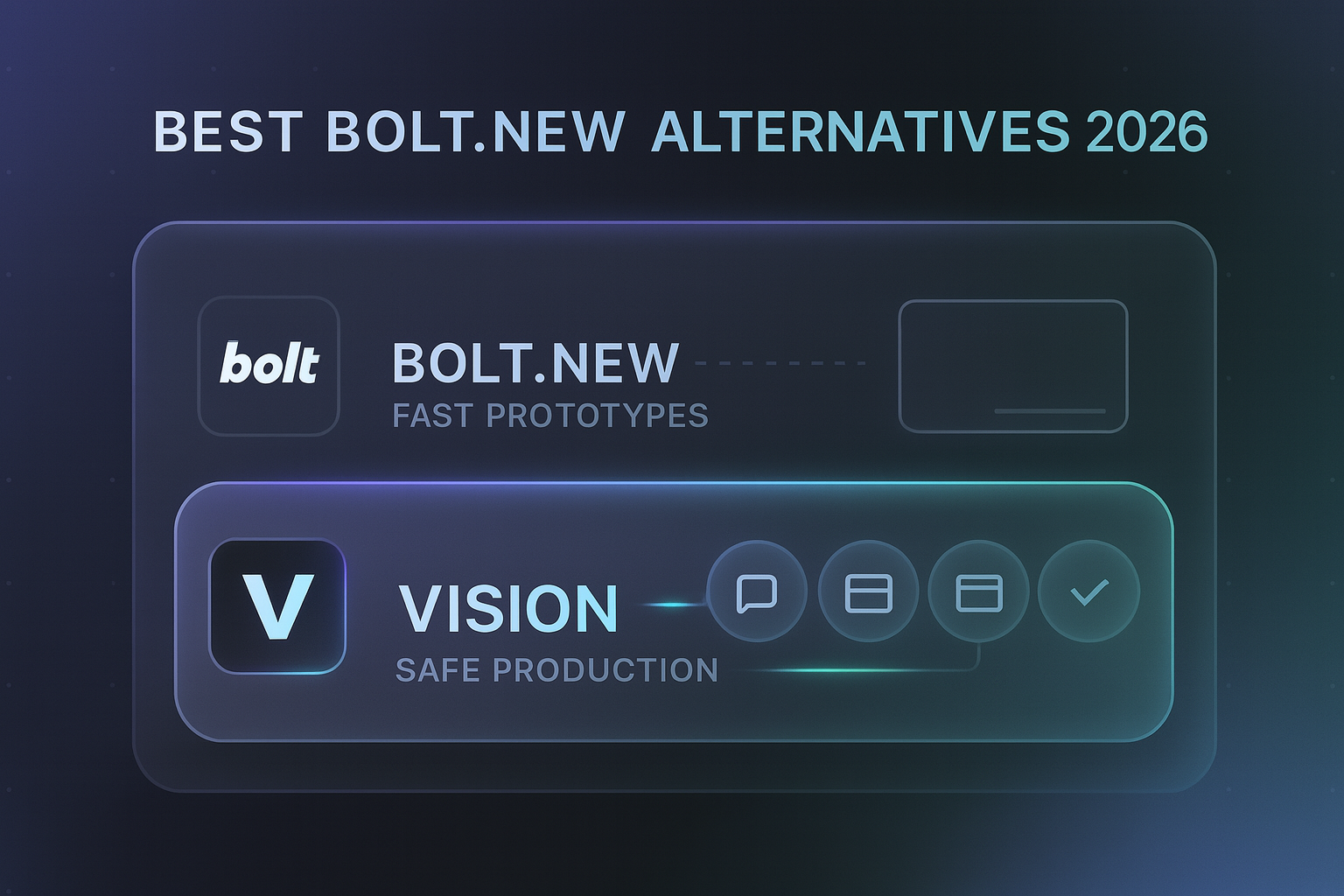
2. Bolt.new (best for fast full-stack prototypes)
Bolt.new by StackBlitz runs a full Node.js environment in your browser and generates React, Next.js, Vue, or Svelte apps from a prompt. It is one of the fastest ways to get a working demo.
Best for: hackathons, MVPs, landing pages, and investor demos.
Tradeoff: token-based pricing scales with project size, and it is weaker on existing production codebases.
3. Replit (best cloud IDE with an AI agent)
Replit combines a browser IDE, Replit Agent, hosting, and databases. It supports more languages than most builders, including Python and Go.
Best for: developers and technical founders who want an all-in-one cloud workspace.
Tradeoff: it is still a developer tool at heart. Nontechnical operators tend to stall once the agent needs guidance.
4. v0 by Vercel (best for UI components)
v0 generates polished React components with shadcn styling and drops neatly into a Next.js project.
Best for: design-quality frontend pieces.
Tradeoff: it produces components, not full internal tools with data and permissions.
5. Hercules (best all-in-one no-code app builder)
Hercules builds full web and mobile apps by chat, with auth, payments, database, and hosting built in.
Best for: small businesses launching standalone apps without developers.
Tradeoff: apps live inside the Hercules platform rather than your own repo and infrastructure.
6. Retool (best drag-and-drop internal tools)
Retool is the established internal tool builder. You connect data sources and assemble UIs from prebuilt components.
Best for: engineering teams that want to hand-build internal tools faster.
Tradeoff: someone technical still has to build and maintain every app, so the backlog problem remains.
7. Superblocks (best for enterprise governance)
Superblocks focuses on enterprise controls: SSO, audit logs, granular permissions.
Best for: large organizations standardizing internal app development.
Tradeoff: heavier setup, and less useful if you want AI to write code in your actual repo.
How do the best Lovable alternatives compare?
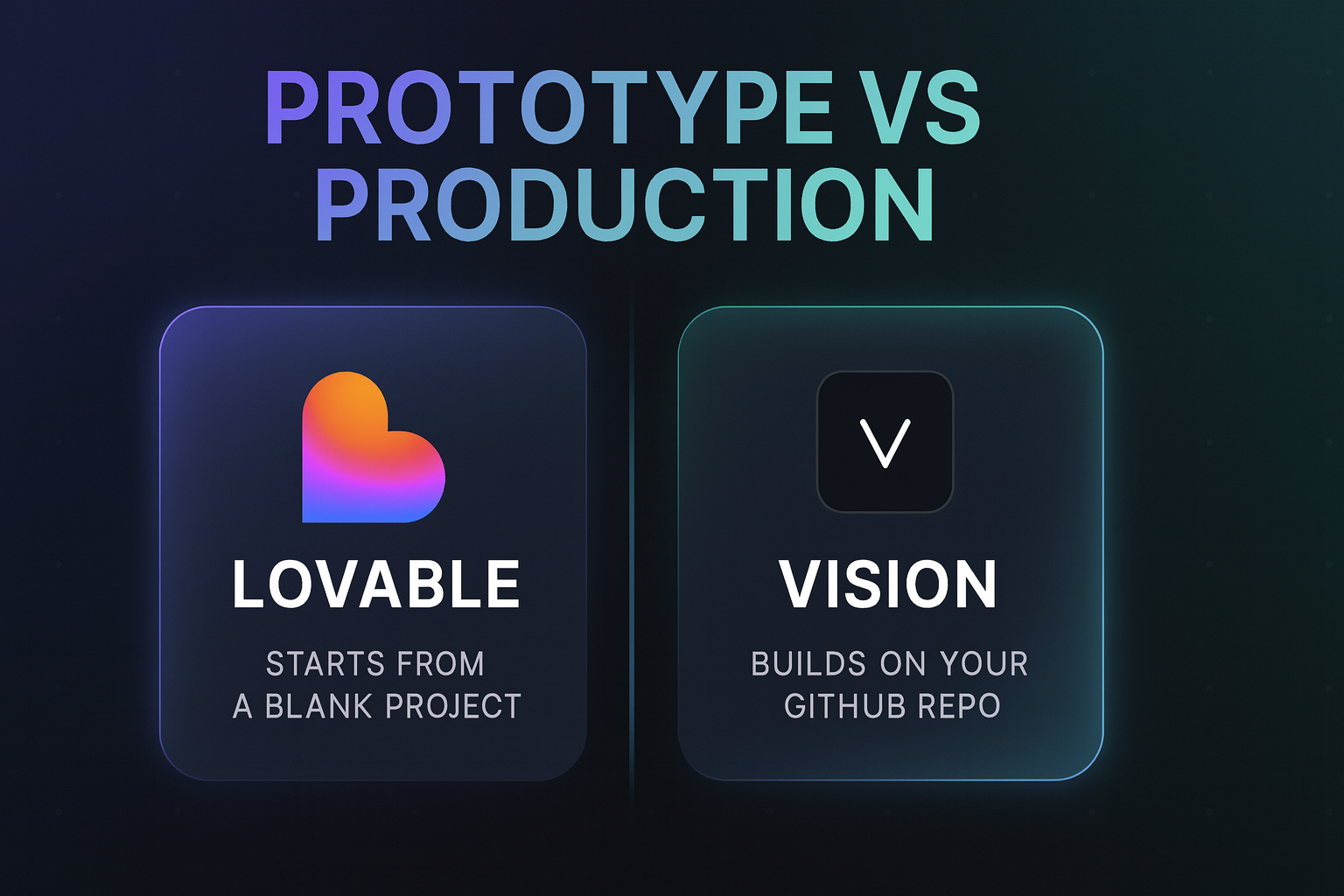
| Tool | Works on existing GitHub repo | Built for nontechnical users | Safe production path | Best for |
|---|---|---|---|---|
| Vision | Yes, connect once | Yes | Preview, promote, rollback | Internal tools on your real codebase |
| Lovable | Limited | Yes | Basic | Greenfield MVPs |
| Bolt.new | Limited | Partly | Deploy via Netlify/Vercel | Prototypes and demos |
| Replit | Yes, for devs | No | Manual | Cloud development |
| v0 | Export to repo | Partly | N/A | UI components |
| Retool | Connects to data, not code | No | App-level | Eng-built internal tools |
How does Vision work in practice?
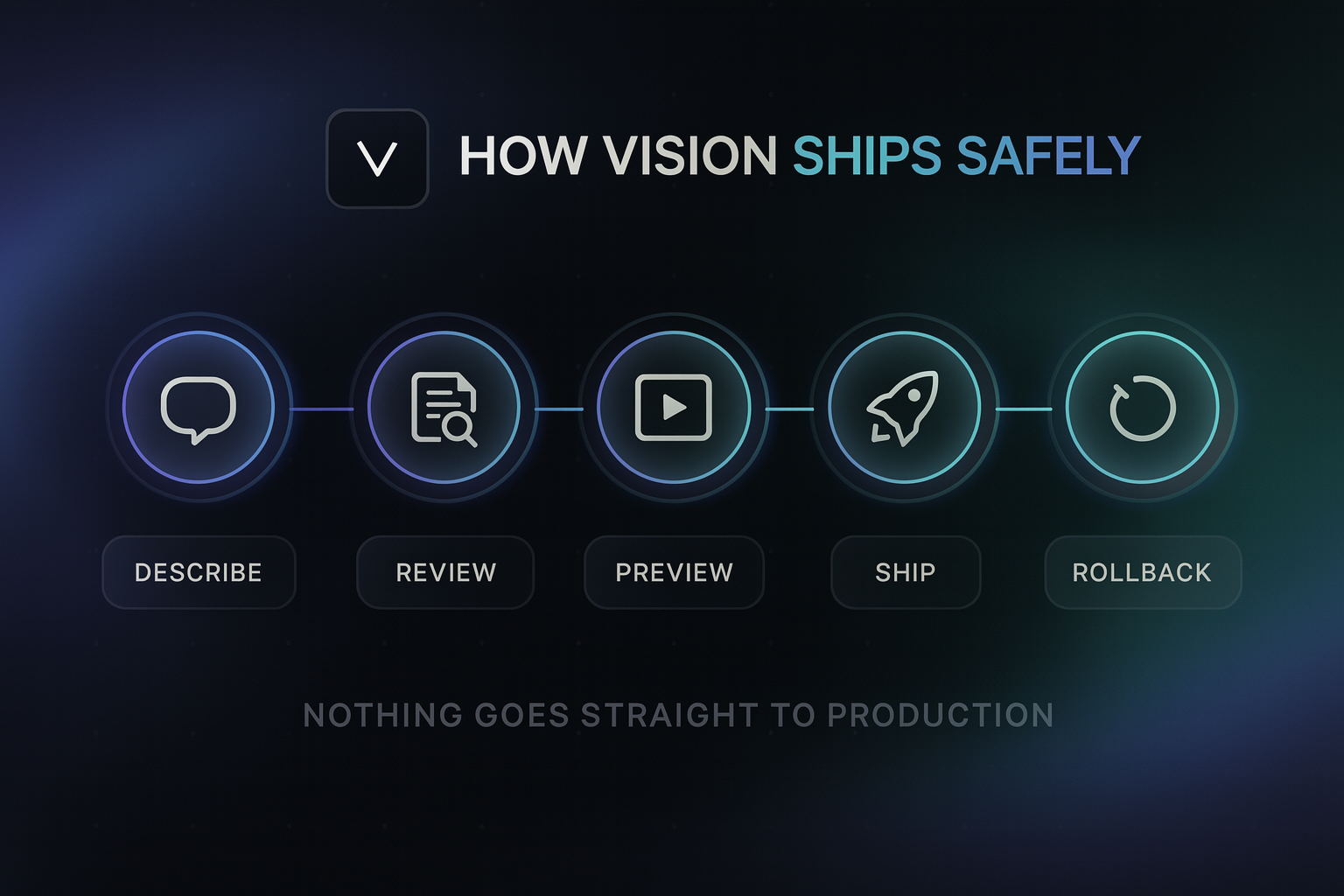
- Connect GitHub once. Vision reads your stack, conventions, and services.
- Describe the tool you need. For example: "Build an admin panel to search customers and refund orders."
- Review the change. Vision writes reviewable code, like a PR from a teammate. Engineers can inspect everything.
- Preview, then promote. Test in a live preview environment. Promote to production when it looks right.
- Roll back in one click if anything is off.
The speed gain is consistent with what the industry has measured for AI-assisted development. GitHub's controlled research found developers completed tasks 55% faster with AI assistance. Vision extends that leverage to people who never wrote code in the first place.
What results do teams see after switching to Vision?
One founding team came to Vision after paying a dev agency roughly $20K a month on a 12-month retainer, and still watching requested features get reclassified as "nice to have" or pushed to a later roadmap. After connecting their GitHub repo to Vision, the founder and their CMO (neither writes code) started shipping changes themselves. A font change across their entire admin panel, which their old agency would have scoped as a two-week job, took about six minutes. Their usage now runs around $300-500 a month, roughly 90% cheaper than the agency. You can compare plans on the Vision pricing page.
What mistakes should you avoid when replacing Lovable?
- Picking another greenfield tool for a brownfield problem. If the tool cannot read your repo, you are rebuilding context from zero.
- Ignoring the production path. Demos are easy. Safe deploys with rollback are what keep your CTO comfortable.
- Forgetting permissions. Internal tools touch customer data. Scoped access matters from day one.
- Buying for one persona. The best outcomes come when nontechnical builders and engineers share one workflow.
What else do people ask about Lovable alternatives?
What is the best alternative to Lovable for internal tools?
Vision. It connects to your existing GitHub codebase, lets nontechnical teammates describe tools in plain language, and ships through preview, promote, and one-click rollback. Lovable is better suited to standalone greenfield apps.
Is Lovable good for production apps?
Lovable is strong for MVPs and new products. For production systems inside an existing company codebase, teams usually need code review, scoped permissions, and rollback, which is where platforms like Vision fit better.
Can nontechnical people really ship code safely?
Yes, with the right guardrails. Vision generates reviewable code, keeps engineers in the approval loop, and isolates changes in preview environments before anything reaches production.
How much does Vision cost compared to Lovable?
Vision is $50 per seat plus usage. Early teams building daily typically land around $300-500 a month total, which customers report is roughly 90% cheaper than a dev agency retainer. Lovable's plans are cheaper for solo greenfield projects but do not cover internal tools on an existing codebase.
Does Vision work with my existing tech stack?
If your code lives on GitHub, yes. Vision reads your repo, learns your conventions and services, and writes changes that match them, whether your stack is Next.js and Supabase or something else entirely.
Ready to ship your first internal tool this week?
If your team is waiting on the engineering backlog for admin panels, reports, or ops tooling, Vision is the fastest safe path. Connect your GitHub, describe what you need, and ship with guardrails your CTO will actually approve.
Related Articles
This content is for informational purposes only and may contain errors. Please contact us to verify important details.