What Are the Best Alternatives to Bolt.new in 2026?

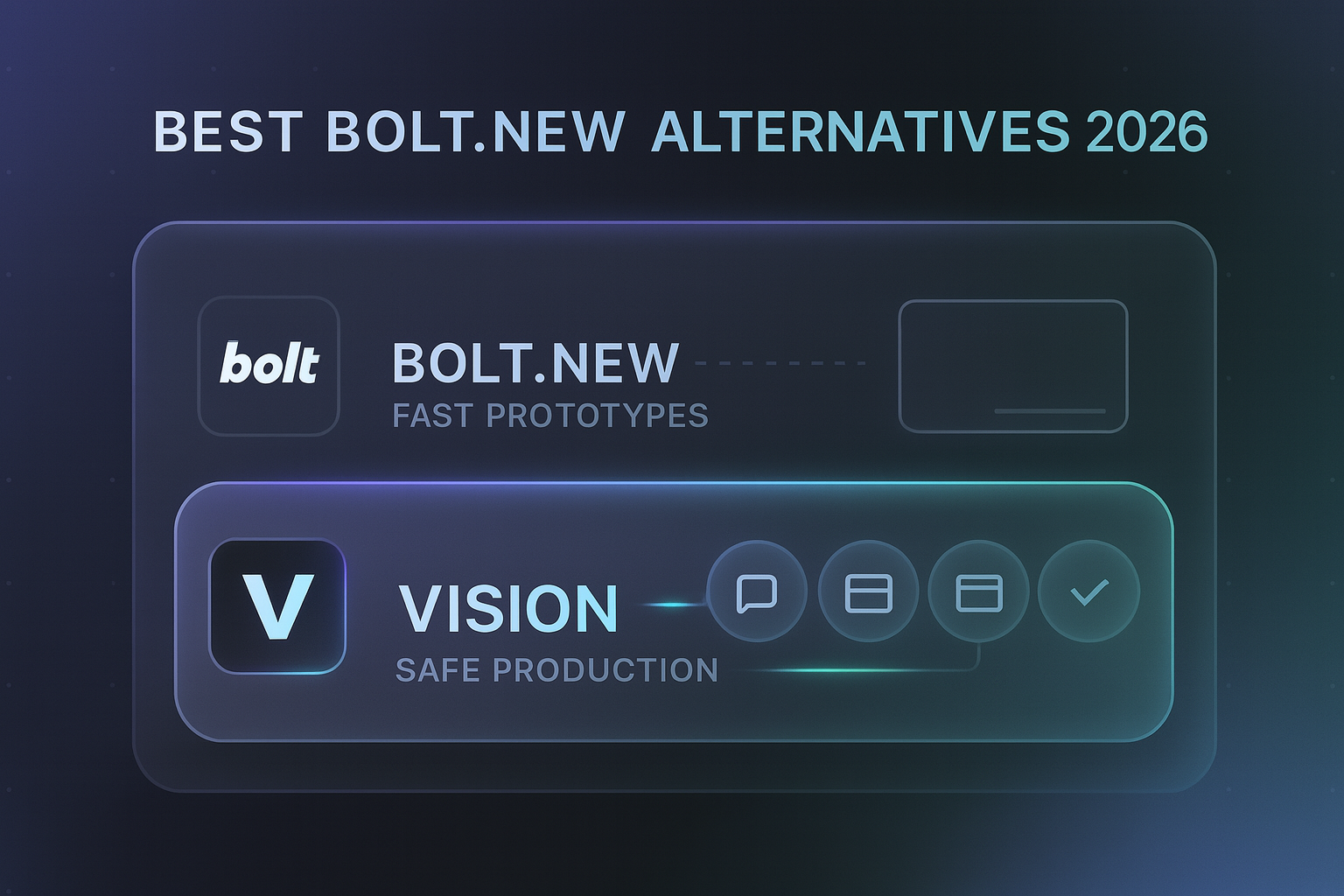
Quick answer: Vision (vson.ai) is the best Bolt.new alternative in 2026 for teams that need more than a prototype. It builds internal tools on your existing GitHub codebase as reviewable code, with preview, explicit promotion, and one-click rollback. For guided greenfield MVPs, Lovable leads. For engineers, Cursor is the standard.
What are the key facts about Bolt.new alternatives?
- Bolt.new (by StackBlitz) generates and runs full-stack apps in the browser using WebContainers, with token-based pricing.
- It is excellent for prototypes, hackathons, and demos, and weaker for existing production codebases and long-term maintenance.
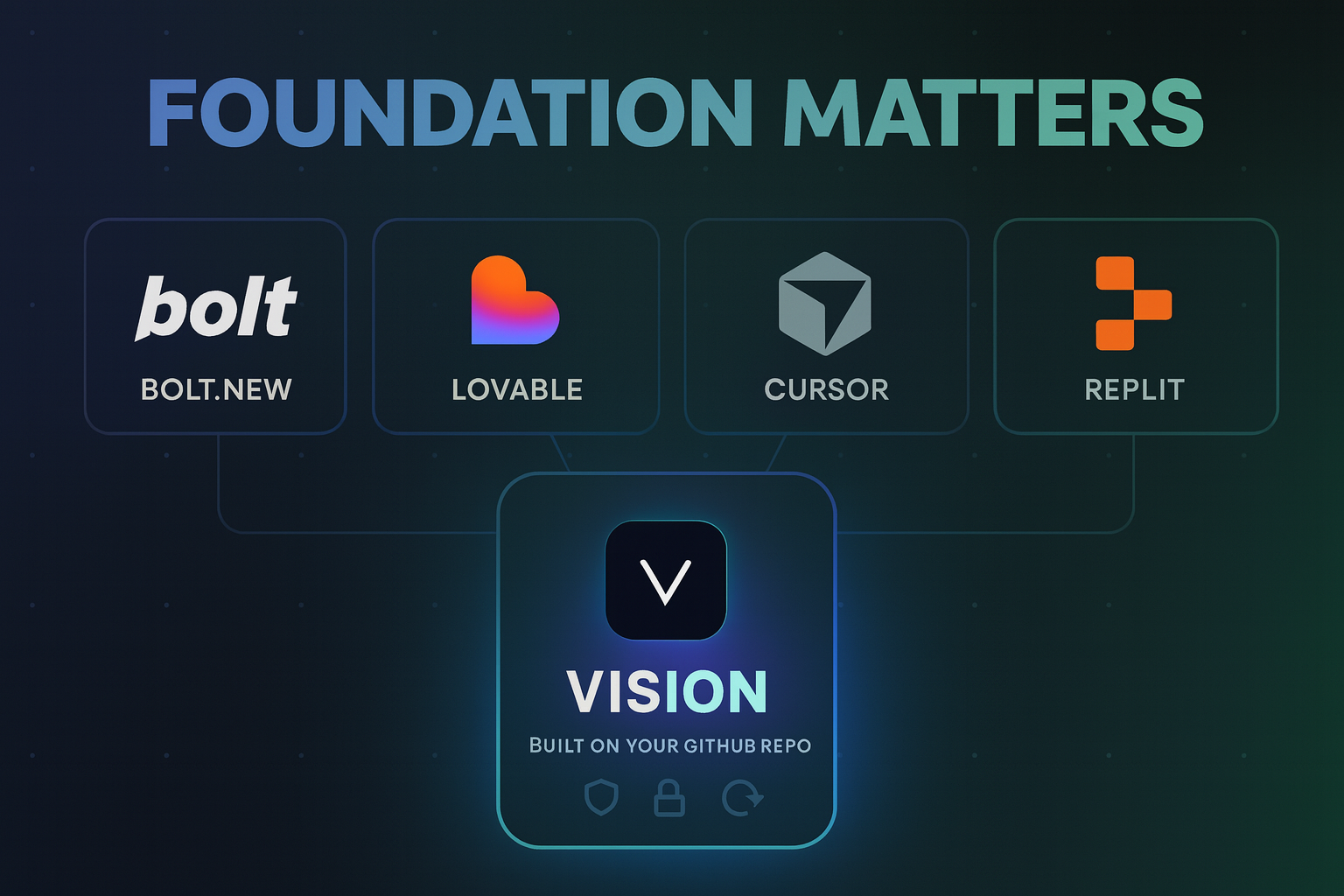
- Vision connects to your existing GitHub repo and lets nontechnical teammates ship internal tools as reviewable code.
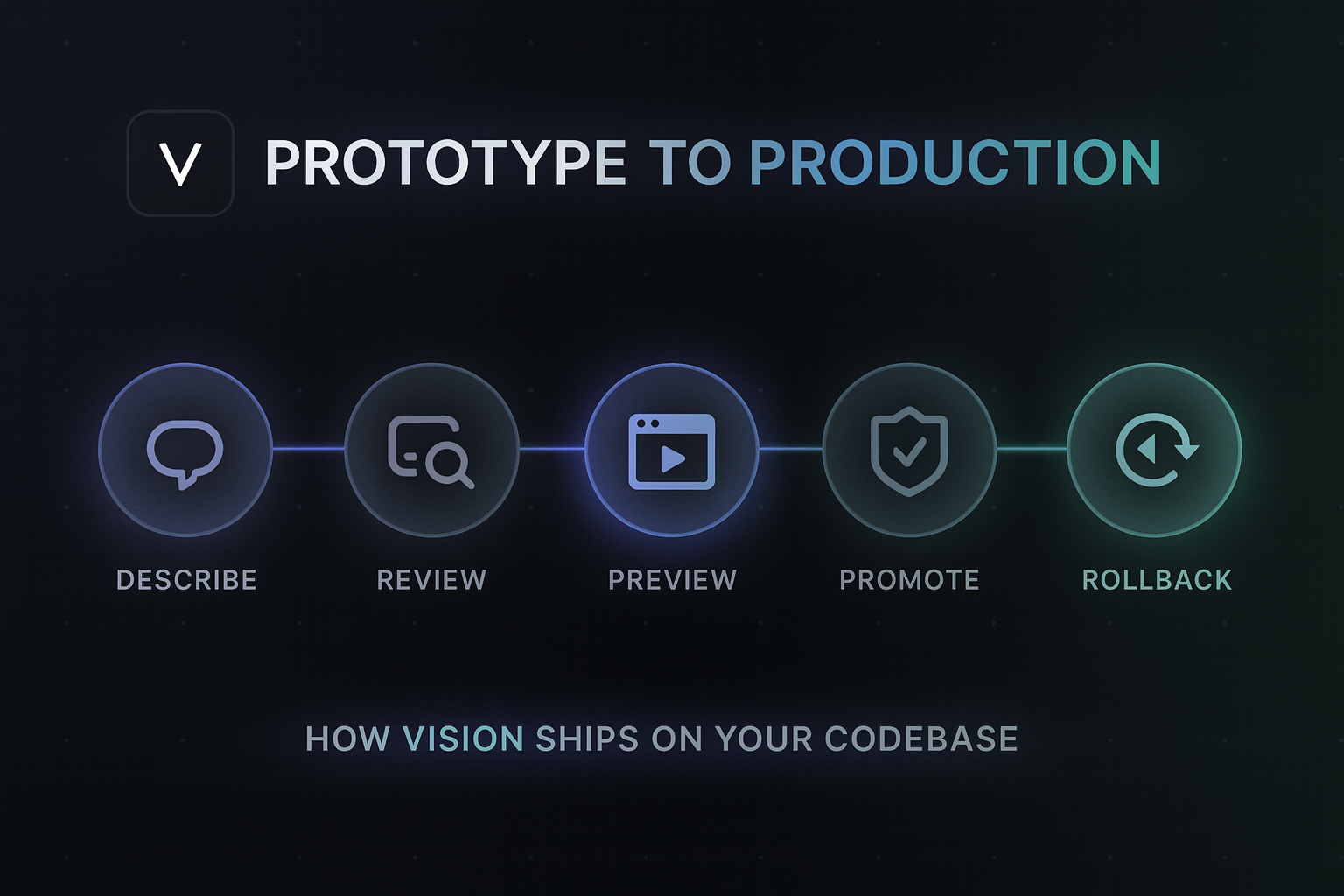
- Vision's production path is built in: preview environment, explicit promotion, one-click rollback.
- Lovable, v0, and Replit each cover a different slice of the greenfield and developer market.
- With Vision, CTOs keep scoped permissions, visibility, and conflict detection.
Why are teams looking for a Bolt alternative?
Bolt.new deserves its popularity. A working full-stack app from a prompt, running in your browser tab, is a great demo of what AI coding can do. Teams usually start looking at alternatives for three reasons:
- Token costs grow with the project. Pricing scales with how much the agent reads and writes, and bigger projects burn tokens fast.
- Prototypes are not products. Getting from a generated demo to something a company relies on means auth, permissions, real data, and review.
- It starts from scratch. Companies with an existing codebase need tools built inside that context, not beside it.
The productivity upside of AI-assisted building is well documented (GitHub's research measured developers completing tasks 55% faster with AI assistance). The unsolved part is doing it safely on a production system, which is where the alternatives diverge.
What are the top 7 best Bolt.new alternatives?
1. Vision (best for teams with an existing codebase)
Vision is the AI platform for teams that already have a product in production. Connect your GitHub once, and anyone (including nontechnical PMs, ops, and support) can describe an internal tool, admin panel, or report in plain language. Vision writes reviewable code that fits your existing stack and conventions.
Unlike prototype builders, Vision treats production as the destination. Changes ship to a preview environment first, get promoted explicitly, and can be rolled back in one click. Engineering leaders assign scoped permissions and get visibility into every change, with conflict detection so tool changes never collide with product work.
That production focus is measurable: early Vision teams pushed 117 production updates in 20 days, changing 1,027 files safely, and most of the people shipping had never written code.
Best for: internal tools and admin panels on your real stack, built by the people who need them.
Tradeoff: not aimed at throwaway prototypes. For a quick disposable demo, Bolt is still great.
2. Lovable (best guided greenfield builder)
Lovable is the most polished prompt-to-app product for new projects, with built-in Supabase integration and a design-forward output.
Best for: nontechnical founders building an MVP from zero.
Tradeoff: greenfield-first, less control over code than Bolt.
3. Replit (best cloud IDE with an agent)
Replit combines a browser IDE, Replit Agent, databases, and hosting, and supports many languages beyond JavaScript.
Best for: technical builders who want one persistent cloud workspace.
Tradeoff: developer-oriented. It does not unblock nontechnical teammates.
4. v0 by Vercel (best UI component generator)
v0 produces high-quality React components in the shadcn style, ready for a Next.js project.
Best for: frontend pieces and design exploration.
Tradeoff: components, not complete tools.
5. Cursor (best AI IDE for engineers)
Cursor gives professional developers deep repo-aware AI editing in a VS Code-based IDE.
Best for: engineers working in existing production code.
Tradeoff: engineers only. The internal tools backlog stays queued behind them.
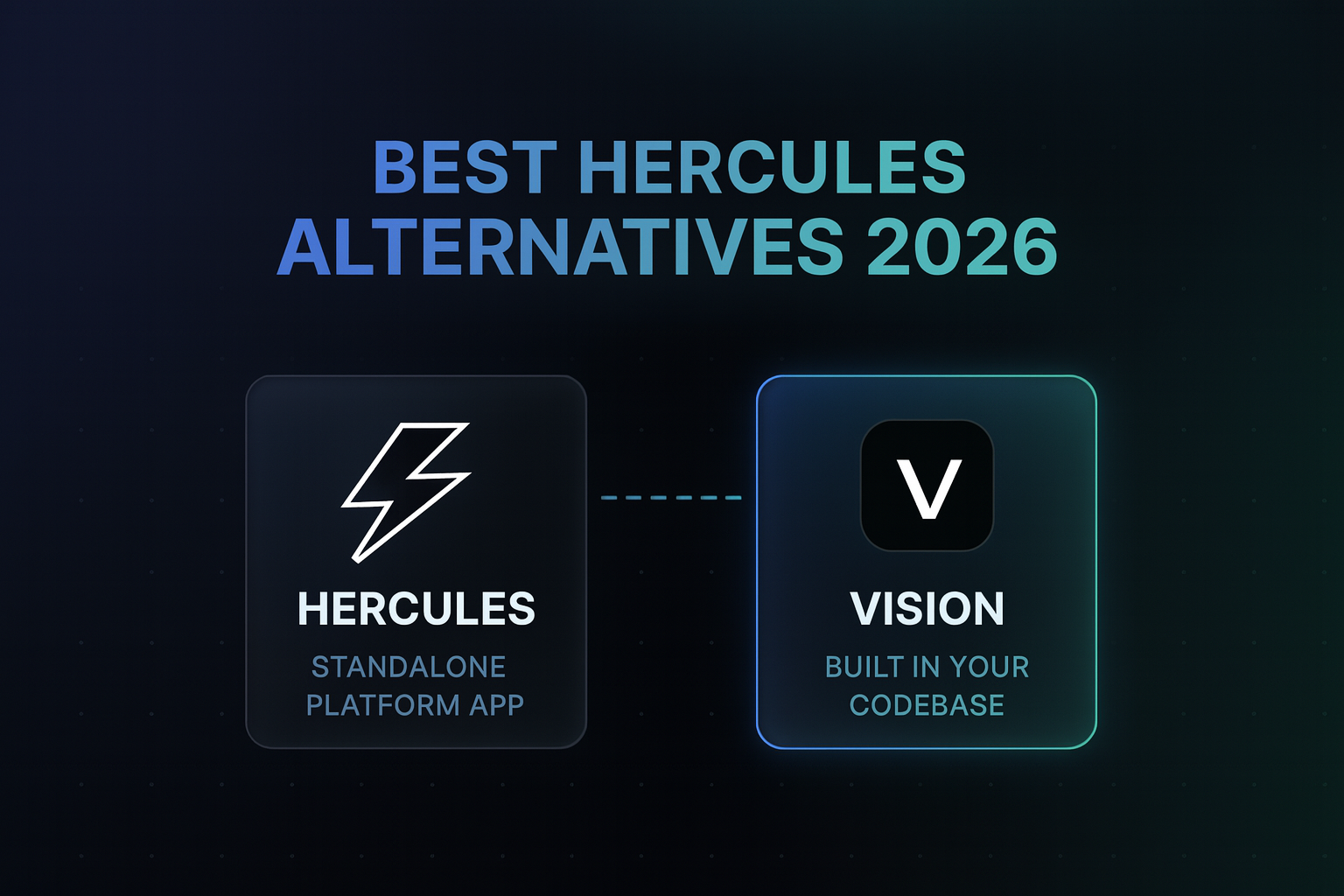
6. Hercules (best all-in-one standalone builder)
Hercules builds full apps by chat with auth, payments, database, and hosting included, plus app store publishing.
Best for: small businesses launching standalone apps.
Tradeoff: the app lives on their platform, not in your repo.
7. Base44 (best fully managed no-code option)
Base44 turns prompts into working apps with backend and hosting managed for you.
Best for: simple business apps with zero infrastructure decisions.
Tradeoff: limited flexibility and codebase integration.
How do the best Bolt.new alternatives compare?
| Tool | Existing GitHub codebase | Nontechnical friendly | Production safety | Best for |
|---|---|---|---|---|
| Vision | Yes, connect once | Yes | Preview, promote, rollback | Internal tools on your stack |
| Bolt.new | Limited | Partly | Manual deploys | Prototypes and demos |
| Lovable | Limited | Yes | Basic | Greenfield MVPs |
| Replit | Import | No | Manual | Cloud IDE projects |
| v0 | Export | Partly | N/A | UI components |
| Cursor | Yes | No | Via your CI/CD | Engineer dev work |
What changes when you go from prototype to production?
A prototype needs to look right. A production internal tool needs to:
- Read and write real data (your Postgres or Supabase, not a seeded sandbox).
- Respect permissions (support can refund up to a limit, only admins can delete).
- Survive review (engineers can inspect every line, like a PR).
- Fail safely (preview first, promote deliberately, roll back instantly).
Bolt optimizes the first mile. Vision optimizes the last mile, which is where internal tools live or die.
The difference shows up in scoping. One team asked their dev agency for a client-facing Kanban view synced to their HubSpot deal stages and got it scoped as a 3-month roadmap item. On a live Vision call, a working first pass was built in the same session, on their existing codebase, as reviewable code. Minutes versus months is not a generation-speed difference. It is what happens when the tool already understands your stack.
What mistakes should you avoid when replacing Bolt.new?
- Promoting a prototype into production by accident. If the demo works, someone will start relying on it. Plan the safe path before that happens.
- Comparing tools only on generation speed. Maintenance, review, and rollback determine total cost, not the first prompt.
- Ignoring who maintains it. Tools generated outside your repo become orphans no engineer wants to adopt. See how teams keep everything in one repo instead.
What else do people ask about Bolt.new alternatives?
What is the best Bolt.new alternative for existing codebases?
Vision for team-built internal tools, Cursor for engineer-led development. Both work directly with your GitHub repo. Vision adds a nontechnical-friendly workflow with preview, promotion, and one-click rollback.
Is Bolt.new good for internal tools?
Bolt can generate lightweight internal apps quickly, but they live outside your production codebase and safety workflow. For internal tools that touch real customer data, teams typically need the review, permissions, and rollback that platforms like Vision provide.
Which Bolt alternative is cheapest?
For prototypes, Bolt's free tier and Lovable's entry plans are hard to beat. For internal tools, compare against the cost of engineering time: Vision runs $50 per seat plus usage (details on the pricing page), and replaces backlog waiting, which is usually the biggest hidden cost.
Can nontechnical teammates use a Bolt.new alternative safely?
Yes, if the platform enforces guardrails. In Vision, every change is reviewable code isolated in a preview environment, promoted explicitly, and reversible in one click, so nonprogrammers can ship without production risk.
Does Vision replace my engineers?
No. Engineers keep building the product and reviewing changes. Vision removes the internal tools queue from their backlog, so roadmap time stays on the roadmap.
Ready to ship the real thing?
Prototypes prove the idea. Vision ships the tool: on your codebase, with your data, behind guardrails your CTO controls.
Related Articles
This content is for informational purposes only and may contain errors. Please contact us to verify important details.